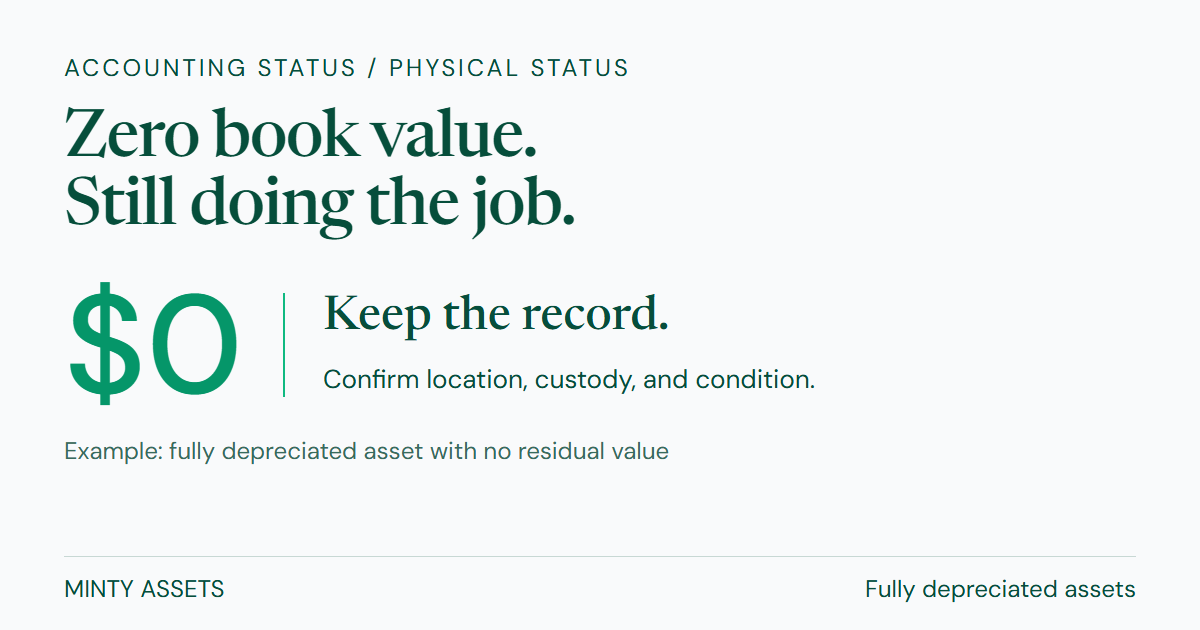
How to Handle Fully Depreciated Assets Still in Use

Does a machine disappear from the fixed asset register when its book value reaches zero? No. Fully depreciated assets can keep producing goods, carrying deliveries, or supporting office work long after their original depreciation schedules end. Removing those records creates a gap between what finance reports and what the business actually owns.
The practical task is to separate three questions: has depreciation finished, does the asset still exist, and what should happen next? Each needs its own evidence. This guide uses straightforward cost-model examples and identifies relevant IFRS requirements; book depreciation and local tax treatment should be assessed separately.
What fully depreciated assets still in use mean
A fully depreciated asset has exhausted its depreciable amount under the applicable estimates. That amount is cost less residual value, so full depreciation does not necessarily mean a zero carrying amount. Residual value is the estimated net disposal amount at current prices for an asset already at its expected end-of-life age and condition.
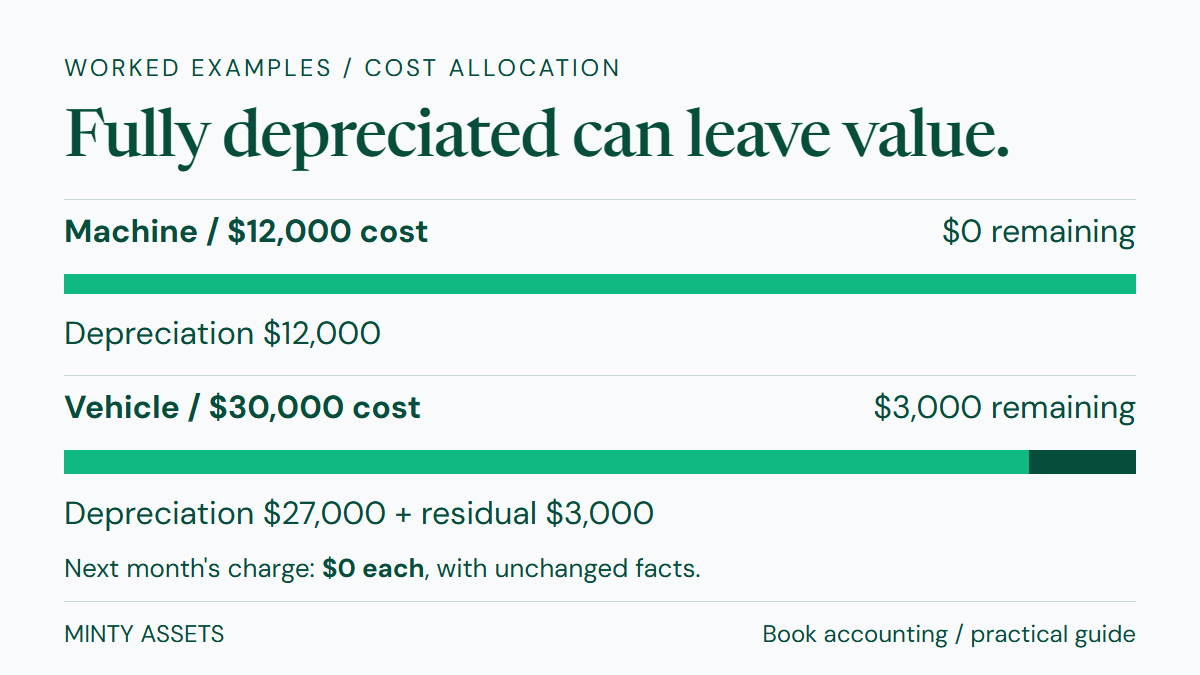
For a simple asset without impairment or revaluation, Net book value equals cost minus accumulated depreciation. A $12,000 machine with no residual value reaches zero after $12,000 of depreciation. A $30,000 vehicle with a $3,000 residual value reaches its depreciation floor after $27,000. Both may remain useful. The net book value guide explains this calculation in more detail.
Neither result tells operations whether to replace the equipment tomorrow. Book value is an accounting measurement, not a condition rating, market quotation, or replacement budget. Under IAS 16, depreciation can cease when an asset is fully depreciated even though it remains in service. See IAS 16, paragraphs 50-55, reproduced in AASB 116.
1. Keep the record and stop further depreciation
Retain the original cost and accumulated depreciation in the register while the asset remains recognized. Finishing the schedule does not create a disposal transaction. For a zero-residual machine, the two balances offset to zero; removing both simply to shorten a report loses useful history without documenting a real event.
Keep the asset number, serial number, location, department, and responsible person current. Record its physical condition and whether it remains in service. If accounting status says "fully depreciated," operations still needs a separate confirmation of use. A status label cannot prove that a laptop is in the cupboard or that a forklift is operating safely.
At the next close, check that the old depreciation charge has stopped. An unchanged asset already at its depreciation floor needs no additional monthly depreciation journal. Investigate a continuing charge before posting: the cause could be an incorrect residual value, duplicate record, or spreadsheet formula copied beyond its intended end date.
Keep the retained balances in the reconciliation to the general ledger. A zero-NBV filter can conceal substantial gross cost and accumulated depreciation, so reconcile those columns individually as well as the net balance. The fixed asset register setup guide provides the underlying record structure.
2. Check zero-value and residual-value examples
Start by calculating the depreciable amount and comparing it with depreciation already recorded. The examples below assume straight-line depreciation, complete years, unchanged estimates, and no impairment, revaluation, or subsequent expenditure. The acquisition and final depreciation entries have already been posted.
| Calculation | Packaging machine | Delivery vehicle |
|---|---|---|
| Original cost | $12,000 | $30,000 |
| Residual value | $0 | $3,000 |
| Useful life | 5 years | 5 years |
| Annual depreciation | $2,400 | $5,400 |
| Accumulated depreciation at end of year 5 | $12,000 | $27,000 |
| Remaining book value | $0 | $3,000 |
| Next month's depreciation, with unchanged facts | $0 | $0 |
For the packaging machine, annual depreciation is $12,000 divided by five. At the end of year five, its original cost remains $12,000 and accumulated depreciation is also $12,000. If production uses it throughout year six, continued use alone does not justify another $2,400 charge or a journal restoring its book value.
For the delivery vehicle, subtract $3,000 before dividing by five: $27,000 divided by five equals $5,400 annually. The remaining $3,000 is not an overlooked expense to force through the final month. It remains a carrying amount subject to the applicable measurement requirements and any later changes in circumstances.
Use these calculations to check the final schedule rather than editing the closing balance directly. When a monthly convention or rounding difference is involved, trace the final charge back to the straight-line calculation and the recorded start date. Preserve the explanation with the reconciliation so the next reviewer can reproduce it.
3. Review useful lives without rewriting history
An asset lasting longer than expected is a reason to revisit estimates, not automatic evidence that past accounts were wrong. Ask what information was available when the useful life was set and what has changed: maintenance, operating hours, replacement plans, or the intensity of use. Keep the explanation specific to the equipment or category.
IAS 16 requires residual values and useful lives to be reviewed at least at each financial year-end. Revised expectations are treated as changes in accounting estimates under IAS 8. See IAS 16, paragraph 51. Review assets approaching the end of their schedules as well as those already fully depreciated, while there may still be an amount to allocate.
A change in estimate affects current and future periods as applicable; it does not reopen correct historical charges. Extending the expected operating life of a zero-carrying-value machine, with no other transaction, supplies no new depreciable amount. If reliable information was ignored in earlier accounts, evaluate whether there was an error instead. IAS 8 distinguishes estimate changes from prior-period errors.
For a practical review file, retain the old estimate, revised expectation, effective date, reviewer, and supporting maintenance or operating evidence. Repeatedly seeing an entire equipment category outlive its schedules merits a broader policy discussion. Avoid assigning every surviving item the same extra two years just to complete a checklist.
4. Record repairs, improvements, and eventual disposal
Assess new spending on its own facts, even when the underlying asset has zero book value. Routine servicing and a qualifying capital addition are different transactions. A maintenance invoice should not automatically restart depreciation on the original purchase, and an improvement should have its own supportable cost and service period.
Suppose the packaging machine receives a $600 routine service. Compare that invoice with a $4,800 modification that adds a separately supportable production capability. Under IAS 16, day-to-day servicing is expensed, while replacement costs meeting recognition criteria are capitalized. The repair versus improvement guide explains the assessment, including replaced components. See also IAS 16, paragraphs 12-13.
When disposal actually occurs, remove the related gross cost and accumulated depreciation and account for any proceeds and remaining carrying amount. If the $12,000 machine is later sold for $1,500 cash, with no selling costs or taxes in this example, the entry is:
| Account | Debit | Credit |
|---|---|---|
| Cash | $1,500 | |
| Accumulated depreciation | $12,000 | |
| Machinery cost | $12,000 | |
| Gain on disposal | $1,500 |
The debits and credits both total $13,500. If the same zero-value machine is scrapped with no proceeds or costs, only the $12,000 cost and accumulated depreciation balances are removed. A vehicle retaining $3,000 book value needs a different gain-or-loss calculation. Follow the asset disposal guide and retain the sale receipt, collection confirmation, or scrapping evidence.
5. Run a year-end review of fully depreciated assets
Use a focused review to connect the accounting list with physical evidence and replacement decisions. Export the relevant records, group them by location or department, and give each group to someone who can confirm what is actually there. Ask for exceptions and evidence, not an unqualified "all fine" reply.
(Minty Assets includes a Fully Depreciated Assets report with category, location, and department filters, plus CSV export.)
| Review question | Evidence or action |
|---|---|
| Does the item exist and remain in use? | Physical check, tag or serial number, named confirmation |
| Is the recorded location correct? | Update custody and transfer records |
| Has depreciation stopped at the right amount? | Final schedule and residual-value check |
| Do useful-life assumptions need attention? | Maintenance history and replacement expectations |
| Was anything sold, scrapped, or replaced? | Disposal evidence and accounting follow-up |
| Is replacement funding needed? | Current quotation, lead time, operational priority |
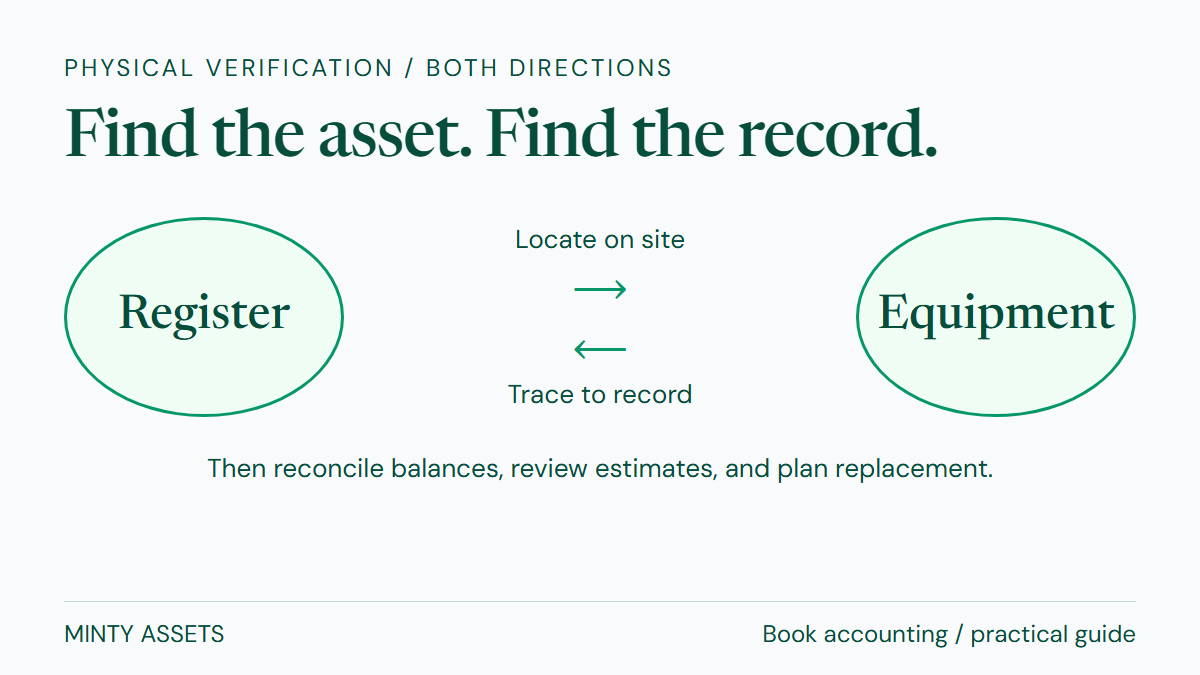
A useful control is to check in both directions: select items from the register and find them, then select equipment on the floor and locate its record. Register-to-floor checks alone miss working equipment that someone deleted from the spreadsheet years ago. Also distinguish a missing item from one transferred to another site before concluding that disposal occurred.
Replacement planning needs current prices and operational priorities. A machine with zero book value could require an expensive replacement with a six-month lead time. Capture that exposure separately from depreciation expense, and have operations rank consequences of failure. Zero depreciation in next year's budget does not mean zero capital spending ahead.
Close the review by assigning owners and dates to unresolved exceptions. Under IAS 16, disclosure of the gross carrying amount of fully depreciated equipment still in use is encouraged, rather than universally required by that paragraph. Assess the applicable reporting requirements and materiality with the financial-statement preparer. See IAS 16, paragraph 79(b).
Frequently Asked Questions
Should fully depreciated assets remain on the register?
Yes. Keep the asset record, gross cost, and accumulated depreciation while the asset remains recognized. Completion of depreciation does not itself mean the equipment has been disposed of.
Can a fully depreciated asset have a nonzero book value?
Yes. An asset with a residual value can finish depreciation with a remaining carrying amount. For example, $30,000 cost less $27,000 accumulated depreciation leaves $3,000.
Should depreciation restart if a zero-value machine stays in use?
Continued use alone does not restart depreciation or restore book value. Extending the expected life of a zero-carrying-value asset creates no new depreciable amount without another relevant transaction.
How is the sale of a fully depreciated asset recorded?
Remove its gross cost and accumulated depreciation, record proceeds, and recognize the resulting gain or loss. Selling a zero-book-value machine for $1,500 produces a $1,500 gain when there are no selling costs or taxes.
Ready to automate your asset register?
Minty Assets handles depreciation, journal entries, and audit-ready reports. Free for up to 50 assets, no credit card required.
Start Free