Capitalize vs Expense: Repair or Improvement?

The invoice says "replace rooftop unit" and the amount is $18,400. Operations calls it a repair because something broke. The facilities manager calls it a replacement. Finance needs one answer before close: should the cost be capitalized, expensed now, or held for more evidence? That is the familiar capitalize vs expense decision.
The distinction matters because it changes both this month's profit and future depreciation. A repair restores an asset to its expected operating condition and is usually expensed when incurred. A capital improvement adds future economic benefit by extending useful life, increasing capacity, improving quality, reducing operating costs, or replacing a significant component. The words on an invoice are useful evidence, but they do not decide the accounting treatment.
The core difference between a repair and an improvement
A repair keeps an existing asset operating at its previous standard. An improvement creates benefits beyond that previous standard or replaces a significant component that is accounted for separately. The decision should be based on the work performed and its expected effect, not on whether the supplier used the word "repair."
Examples of repairs include fixing a leaking pipe, replacing worn belts in a machine, repainting an office, or servicing a vehicle to keep it roadworthy. These activities maintain expected performance. Examples of improvements include adding a production line that increases output, installing a major building system that extends service potential, or replacing a significant component whose future benefit will be consumed over several years.
Under International Accounting Standard 16 (IAS 16), day-to-day servicing costs are recognized in profit or loss as incurred. The standard also requires an entity to recognize the cost of replacing part of an item of property, plant, and equipment when recognition criteria are met, and to derecognize the carrying amount of the replaced part. When the original component was not separately identified, use a supportable estimate, such as replacement cost as an indication where appropriate, under the applicable framework. US GAAP has different detailed guidance and company policies, so confirm the framework and capitalization policy that applies to the entity.
Use a decision framework before coding the invoice
The fastest way to make consistent decisions is to ask the same questions every time. The answers should be recorded with the invoice or asset event, especially for material amounts.
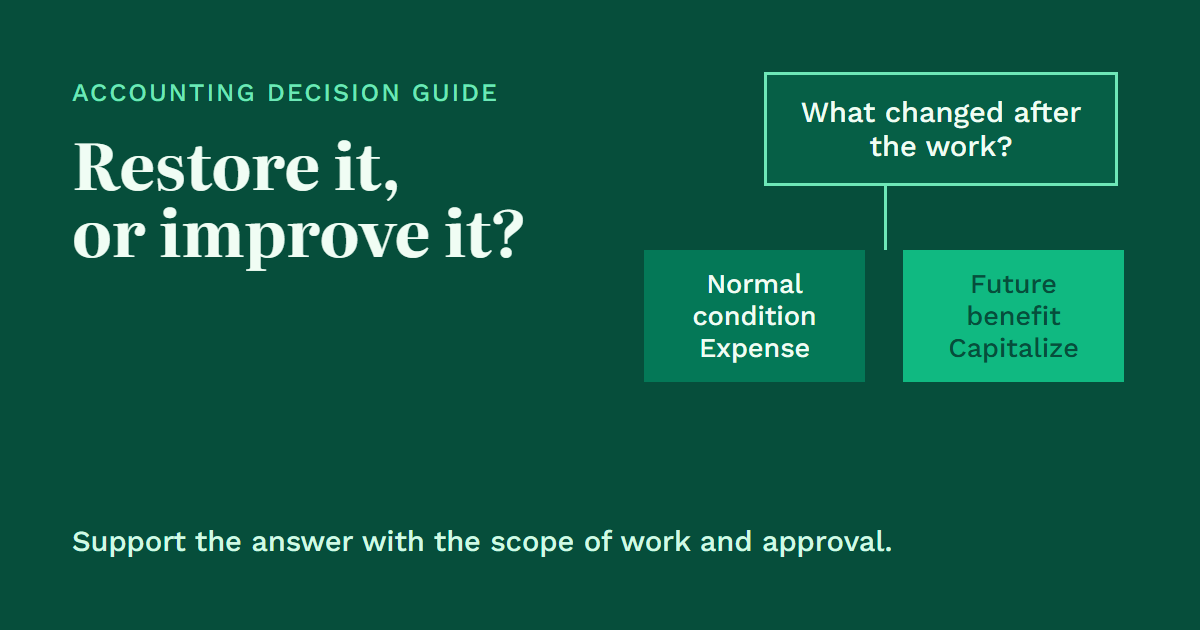
- What was the asset's condition before the work? If the item was operating as intended and the work only restored that state, expense treatment is a strong starting point.
- What changed after the work? Look for increased capacity, lower operating cost, improved output or quality, a longer useful life, or a new function.
- Is a significant component being replaced? A component replacement can be capitalized even when it feels like maintenance, if it provides future benefit and meets the entity's policy.
- Is the amount material under the capitalization policy? A qualifying improvement may be expensed for administrative practicality only when that treatment is not material individually or in aggregate; applying the policy consistently is necessary but not sufficient.
- Can the cost be supported? A capitalized amount needs an invoice, approval, description of the work, in-service date, and a reasonable useful-life assessment.
The questions do not turn accounting into a mechanical checklist. They make the rationale visible. When the conclusion is close, a short memo that explains the operational change is more useful than a vague notation such as "capital project." The capitalize vs expense conclusion should be clear from that record.
For recurring categories of spend, keep a few approved examples with the policy. They help preparers apply the capitalize vs expense framework consistently without treating every invoice as identical.
Capitalize vs expense: applying the framework
HVAC work: repair or component replacement?
Assume a business spends $4,200 to repair a failed fan motor in an existing rooftop HVAC unit. The work restores cooling to the level the building had before the failure. Nothing about capacity, efficiency, or expected life of the unit materially changes. This is a repair expense.
Now change the facts. The business spends $18,400 to replace an outdated rooftop unit with a higher-efficiency unit expected to serve the building for 12 years. The replacement delivers a new future benefit and is significant relative to the building system. Subject to the company's policy and evidence, capitalizing the replacement as a new component is supportable. The carrying amount of the old component should be removed if it can be determined or reasonably estimated under the applicable accounting framework.
Manufacturing equipment: maintenance versus capability
Replacing $900 of worn bearings on a packaging machine is ordinary maintenance when it keeps the original machine operating. Adding a $36,000 automated feeder that increases line throughput by 25 percent is different. The feeder increases capacity and can be tracked as an improvement or separate component with its own useful life.
Do not capitalize a routine maintenance program simply because the total annual spend is large. Ten recurring repairs remain repairs when they only sustain normal operation. Conversely, a single project may contain both repair and improvement elements. Split the invoice or obtain a supplier breakdown rather than forcing the whole project into one account.
Office space: refresh or leasehold improvement?
Painting and patching an office is maintenance. Reconfiguring a space with new partitions, electrical work, and permanent fixtures to support a new department may create a leasehold improvement. Under the applicable framework and lease terms, the useful life should reflect the period the company expects to benefit, which can be limited by the lease term. Do not assume a building-style life is appropriate for a tenant improvement.
Record the accounting correctly
The journal entry follows the conclusion. A repair is recorded as an expense when incurred:
| Repair journal entry | Debit | Credit |
|---|---|---|
| Repairs and maintenance expense | $4,200 | |
| Cash or accounts payable | $4,200 |
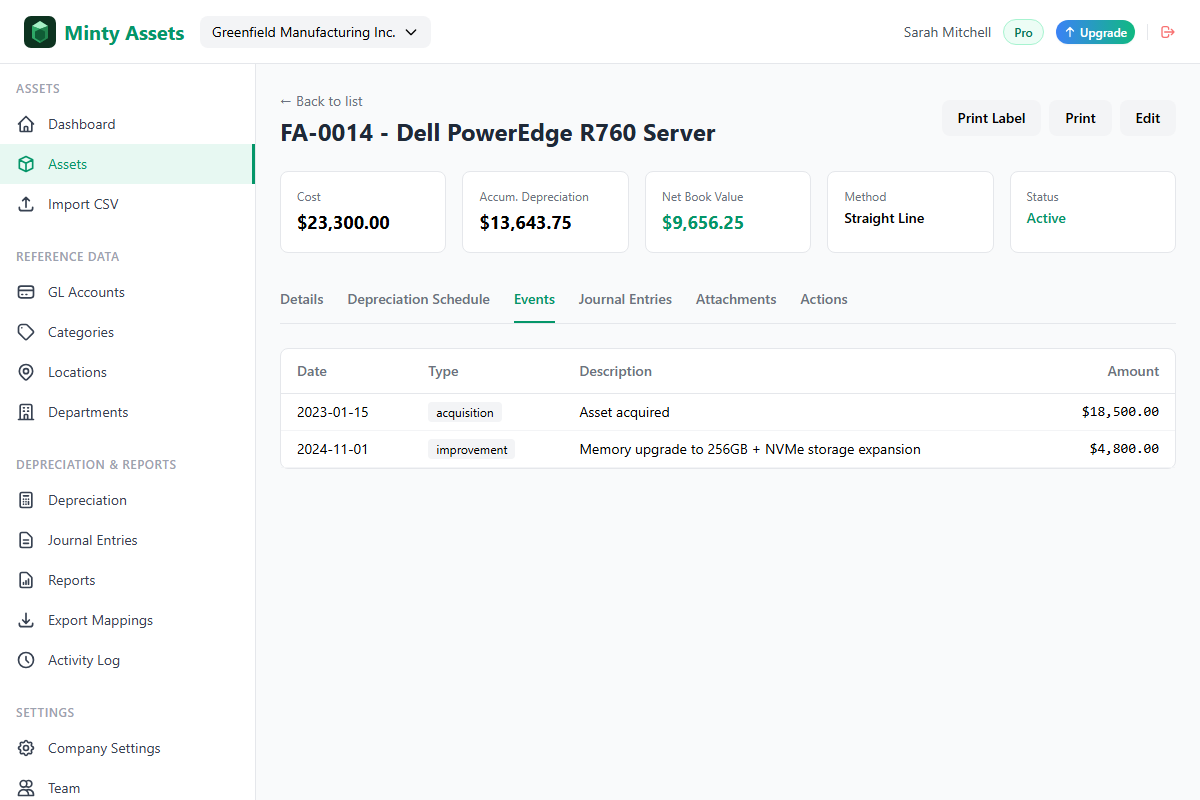
An eligible improvement is recorded as an asset cost and depreciated prospectively over its useful life. If it is an additional cost layer on an existing asset, the new layer may have a different life from the original asset.
| Improvement journal entry | Debit | Credit |
|---|---|---|
| Building improvements or equipment | $18,400 | |
| Cash or accounts payable | $18,400 |
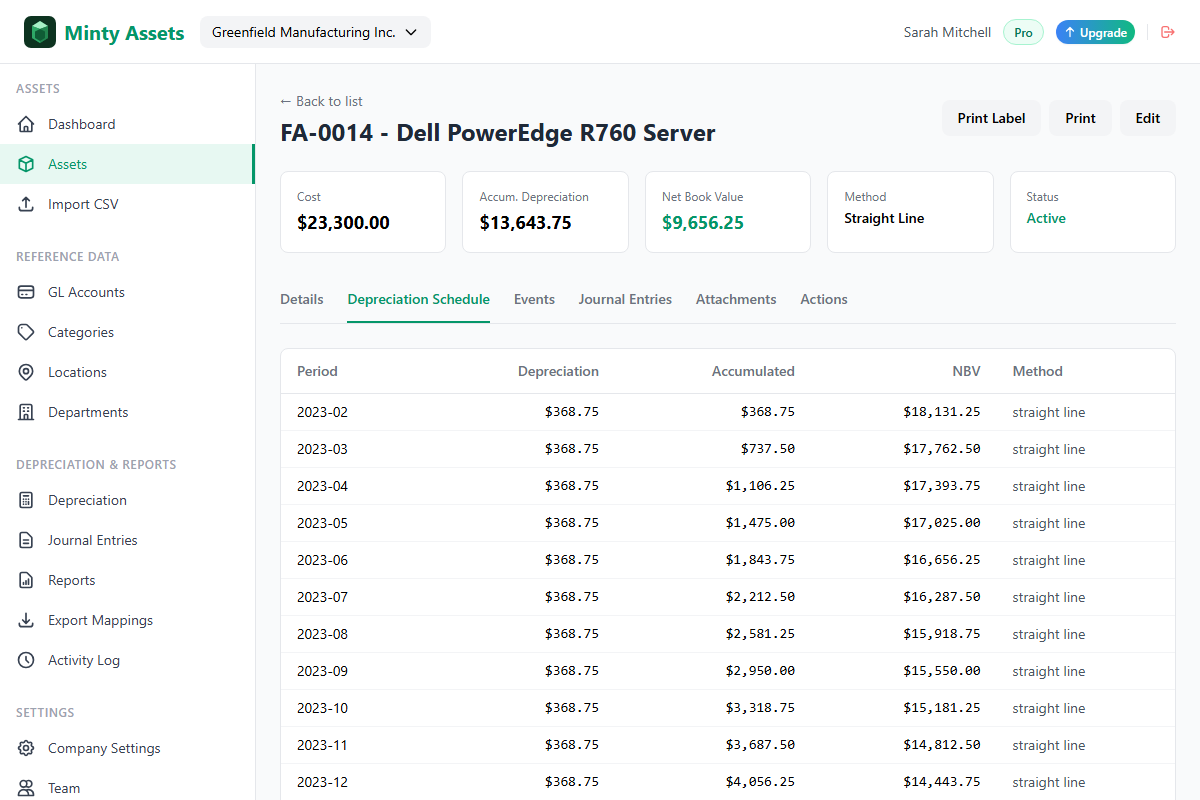
For a $18,400 component with a 12-year useful life and no residual value, straight-line depreciation is $1,533.33 per year, or $127.78 per full month. The calculation should start when the component is available for use under the company's selected depreciation convention. This additional depreciation is why an improvement should not simply overwrite the original asset cost and life.
When the replacement is recognized, derecognize the replaced component's carrying amount under the applicable framework. That avoids continuing to depreciate something the company no longer controls. If the original component was not separately identified, develop and document a supportable estimate rather than leaving the replaced component in service indefinitely. Do not invent a disposal amount merely to make the register look neat.
(Minty Assets records an improvement as a separate cost layer, preserves the asset's event history, and calculates future depreciation prospectively.)
Documentation that survives review
Good documentation answers the question an unfamiliar reviewer will ask six months later: what did the company get for this spend? Keep the invoice, approval, work order, completion or in-service date, and a short description of the expected benefit. For a component replacement, retain details about the old component and how its carrying amount was addressed.
Use clear descriptions. "HVAC upgrade - 12-year rooftop unit replacement, increased efficiency" is far better than "facility repair." For a repair, record why the work restored normal condition rather than increasing capability. The goal is not to write a legal brief for every invoice. It is to retain enough context to make the treatment reproducible.
An experienced controller also checks for patterns. Several large "repairs" to the same machine in a short period may indicate a replacement project that was split across invoices. Several capitalized costs that only maintain normal operation may indicate that the policy is being applied too aggressively. Reviewing these patterns quarterly is more effective than trying to solve every borderline invoice in isolation.
Common mistakes to avoid
The common mistake is treating a label as a conclusion. Suppliers may call a substantial replacement a repair, while an internal project title may call a routine refresh an upgrade. Read the scope of work and ask what future benefit changed.
Another mistake is using tax treatment as the book-accounting answer. Tax rules and book policies can differ materially. This article addresses book accounting principles; obtain tax advice for deductions, elections, and jurisdiction-specific rules.
Finally, do not capitalize an item and forget to start depreciation, or expense it and leave an old component depreciating indefinitely. The accounting decision is complete only when the register, depreciation schedule, journal entry, and supporting documents tell the same story. The fixed asset journal entry guide explains how those records connect for acquisitions, depreciation, improvements, and disposals.
Put the framework into your monthly close
Add one review step to the monthly capital expenditure process: flag invoices that exceed the capitalization threshold or describe a replacement, upgrade, expansion, renovation, or major overhaul. Ask the decision questions, retain the evidence, and send unresolved items to the person authorized to interpret the policy.
This produces a register that reflects the physical assets the business is using and financial statements that recognize cost in the periods that benefit from it. When a future reviewer asks why a cost was capitalized or expensed, the answer should be available from the record, not from someone's memory.
Frequently Asked Questions
What is the difference between a repair and a capital improvement?
A repair restores an asset to its expected condition. A capital improvement creates future economic benefit by extending useful life, increasing capacity, improving quality, reducing operating costs, or replacing a significant component.
Can a replacement be capitalized?
A replacement can be capitalized when it meets the applicable recognition criteria and provides future benefit. Under IAS 16, the carrying amount of the replaced part is derecognized when the replacement is recognized.
Does a capitalization threshold decide every repair-versus-improvement question?
No. A threshold is an administrative materiality policy. It does not justify expensing a qualifying cost that is material individually or in aggregate.
Ready to automate your asset register?
Minty Assets handles depreciation, journal entries, and audit-ready reports. Free for up to 50 assets, no credit card required.
Start Free