Depreciation Start Conventions Explained

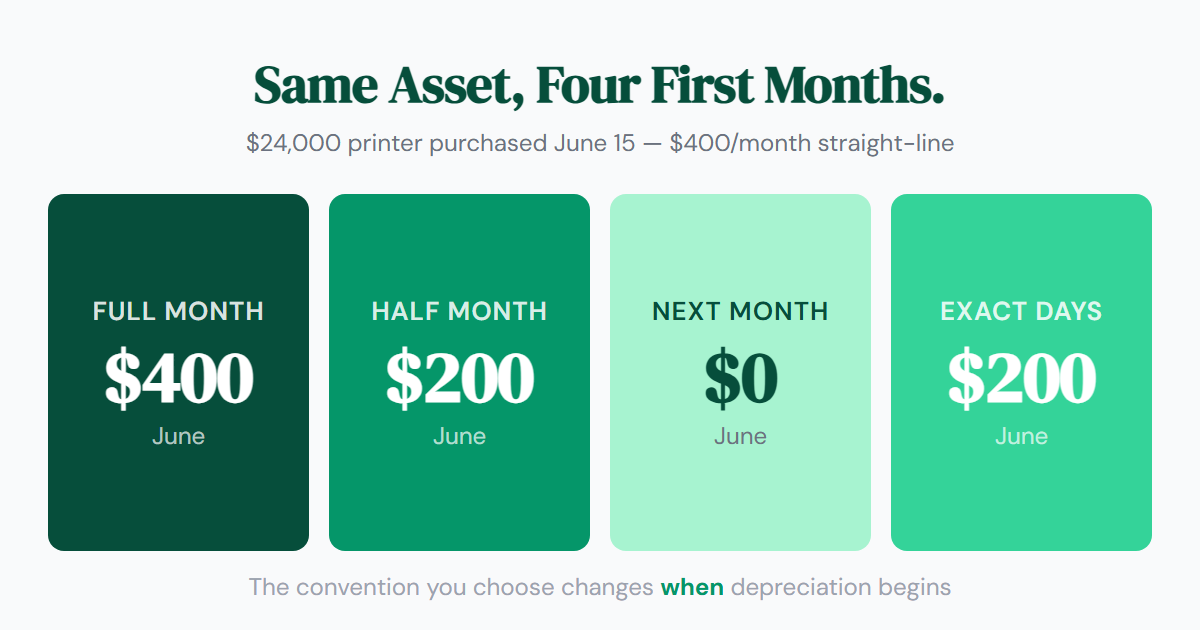
Two companies buy the same $24,000 printer on June 15. Company A records $400 in depreciation that month. Company B records zero. Both are correct. The difference is a single setting called the depreciation convention, and it affects every asset in the register from its first month of depreciation through its last.
The convention determines how depreciation is calculated in the month an asset is acquired. It's a company-level policy choice, not an asset-by-asset decision, and once set it should apply consistently to every asset. This guide explains each of the four standard conventions, shows the dollar impact on the same asset, and helps you pick the right one for your company.
What Is a Depreciation Start Convention?
When you buy an asset mid-month, a question arises: how much depreciation do you record in that first partial month? The asset wasn't in service for the full period, so do you charge a full month, a half month, nothing, or a prorated amount based on exact days?
The answer is your depreciation convention. It's set once at the company level and applies to all assets going forward. The four standard options are:
- Full Month - a full month's depreciation regardless of purchase date
- Half Month - half a month's depreciation in the acquisition month
- Next Month - no depreciation until the month after acquisition
- Exact Days - prorated based on the actual days remaining in the month
The convention only affects two periods in an asset's life: the first month (acquisition) and the last month (when the asset reaches its residual value). Every month in between gets a standard full month of depreciation regardless of convention.
Full Month Convention
The full month convention records a full month of depreciation in the acquisition month, regardless of the day the asset was purchased.
Rule: Record a full month of depreciation in the acquisition month, regardless of purchase date.
An asset bought on June 1 gets the same June depreciation as one bought on June 28. The purchase date within the month doesn't matter.
Using our $24,000 printer example ($0 residual, 60-month useful life, monthly depreciation = $400):
- Purchased June 15
- June depreciation: $400 (full month)
- Year 1 total (June-December): $2,800 (7 months x $400)
- Final month: the asset fully depreciates one month earlier than its calendar useful life, since it got credit for a full first month
Why controllers choose it: Simplicity. There's no proration calculation, no day-counting, and no partial amounts to explain. It's slightly conservative (you recognize expense earlier), which auditors prefer. Full month is the most common convention for SMEs because it eliminates complexity without materially affecting financial statements for companies with regular acquisition patterns.
Half Month Convention
The half month convention records half a month's depreciation in the acquisition month, regardless of the specific purchase date within that month.
Rule: Record half a month's depreciation in the acquisition month.
This is a compromise between full month and exact days. The logic is straightforward: regardless of when in the month you bought the asset, you get half a month's depreciation. No day-counting needed.
Same $24,000 printer:
- Purchased June 15
- June depreciation: $200 (half of $400)
- Year 1 total: $2,600 (half month + 6 full months)
- Final month: a half-month of depreciation is also recorded in the last month to balance the total
Why controllers choose it: It's a middle ground. Half month is common in tax depreciation contexts (MACRS uses a half-year convention, which is the annual equivalent of this concept). Some companies adopt half month for book purposes to align with their tax treatment, reducing the book-tax difference and simplifying deferred tax calculations.
Next Month Convention
The next month convention records no depreciation in the acquisition month and starts depreciation on the first day of the following month.
Rule: No depreciation in the acquisition month. Depreciation starts the first day of the following month.
An asset purchased on June 15 doesn't start depreciating until July 1. The entire first month is treated as a setup or commissioning period.
Same $24,000 printer:
- Purchased June 15
- June depreciation: $0
- July depreciation: $400 (first full month)
- Year 1 total (July-December): $2,400 (6 months x $400)
- Final month: the asset depreciates one month beyond its nominal useful life end date
Why controllers choose it: It matches the reality that many assets aren't actually in productive use the day they arrive. A piece of equipment needs installation, configuration, or testing before it starts generating value. The next-month convention recognizes this gap. It's also the most conservative option - depreciation expense starts later, meaning reported profits are slightly higher in the acquisition period.
Experienced controllers know that the next-month convention also simplifies month-end close during heavy acquisition months. If you buy 10 assets in the last week of March, you don't need to squeeze them into March's depreciation run. They'll pick up naturally in April.
Exact Days Convention
The exact days convention prorates first-month depreciation based on the actual number of days remaining in the month after the acquisition date.
Rule: Prorate the first month's depreciation based on the actual number of days remaining in the month after the acquisition date.
This is the most precise convention. An asset purchased on June 15 gets depreciation for 15 out of 30 days (or 16 out of 30, depending on whether the acquisition date itself is included).
Same $24,000 printer (purchased June 15, 15 remaining days in June out of 30):
- June depreciation: $200 (15/30 x $400)
- Year 1 total: $2,600 (prorated first month + 6 full months)
- Final month: a prorated amount is recorded to bring the total exactly to the depreciable amount
Note: in this example, exact days and half month produce the same result because June 15 happens to be exactly mid-month. For a June 5 purchase, exact days would give $333.33 (25/30 x $400), while half month still gives $200.
Why controllers choose it: Precision. Exact days produces the most accurate first-month depreciation, which matters for companies that acquire high-value assets throughout the month and want their period-end financial statements to reflect the exact economic consumption. It's common in industries with large, infrequent asset purchases - a $2M piece of production equipment acquired on the 3rd vs. the 28th produces a materially different first-month charge under exact days.
The downside is complexity. Monthly depreciation amounts vary depending on the acquisition date and the number of days in the month (February, for example, has fewer days than March). This makes forecasting harder and introduces more variability into monthly depreciation totals.
Side-by-Side: Same Asset, Four Conventions
Running our $24,000 printer through all four conventions shows how the same acquisition produces four different first-month and Year 1 results, even though the total depreciation over the asset's life is identical.
Our $24,000 printer purchased June 15, $0 residual, 60-month useful life, $400/month:
| Convention | June Depreciation | Year 1 Total | First Full Year (12 months from start) | Total Over Life |
|---|---|---|---|---|
| Full Month | $400 | $2,800 | $4,800 | $24,000 |
| Half Month | $200 | $2,600 | $4,600 | $24,000 |
| Next Month | $0 | $2,400 | $4,400 | $24,000 |
| Exact Days | $200 | $2,600 | $4,600 | $24,000 |
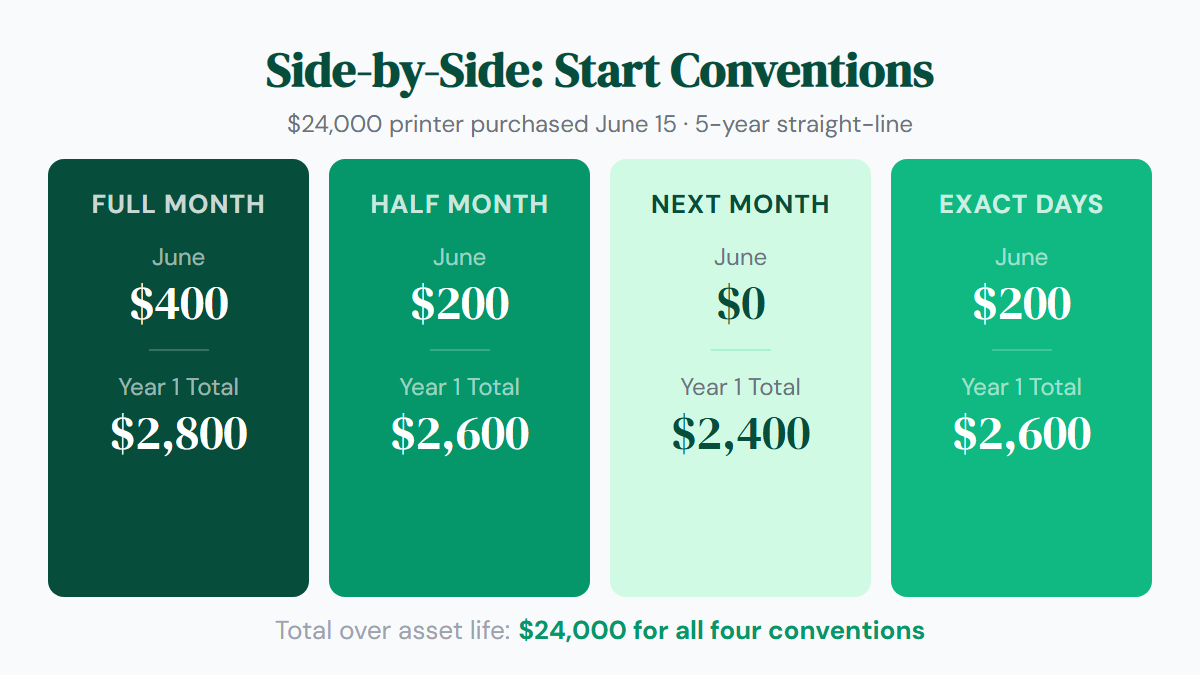
The total over the asset's life is identical regardless of convention - $24,000 in every case. The convention only shifts when that expense is recognized, not how much. The difference between the most aggressive (full month) and most conservative (next month) in Year 1 is $400 - one month's depreciation.
For a single $24,000 printer, the difference is immaterial. But scale that across 200 assets acquired throughout the year, and the convention choice can shift thousands of dollars between reporting periods. This is why auditors verify that the convention is applied consistently and hasn't changed between periods.
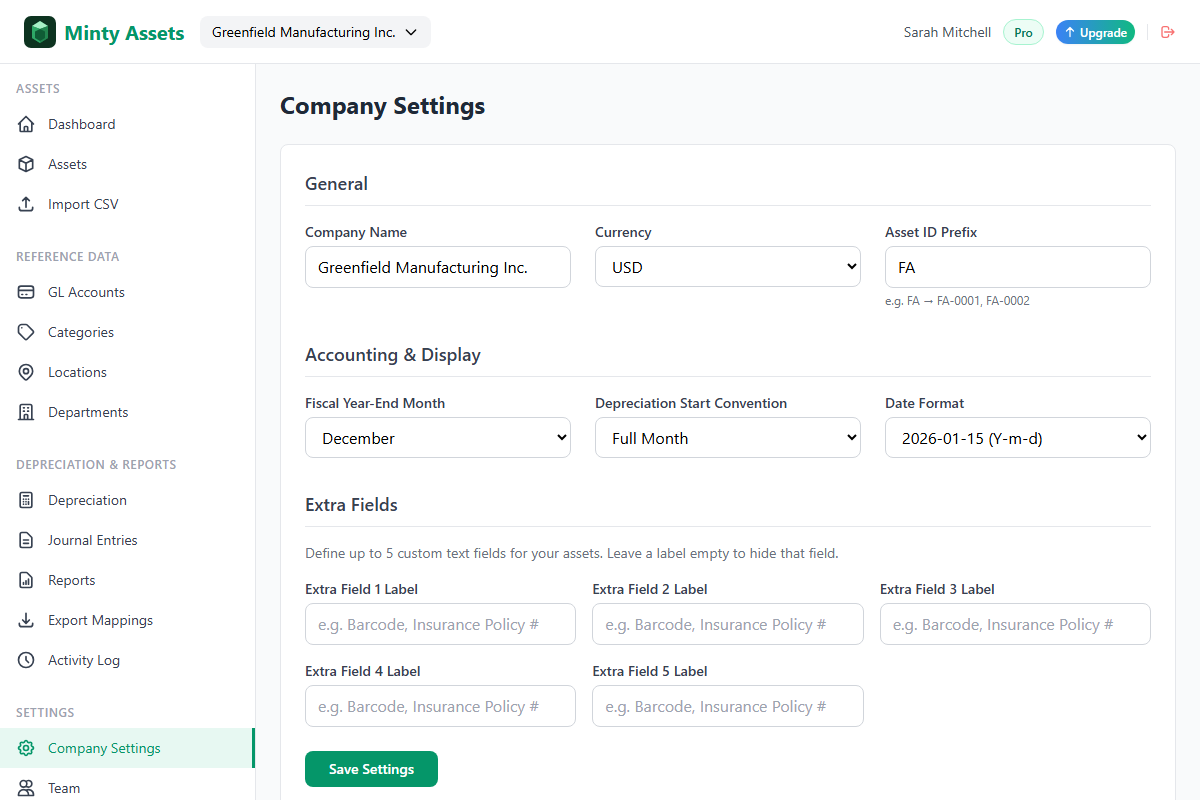
(Minty Assets applies your chosen convention automatically to every asset. Set it once in company settings, and all depreciation calculations - preview, posting, and journal entries - respect it.)
Which Convention Should You Choose?
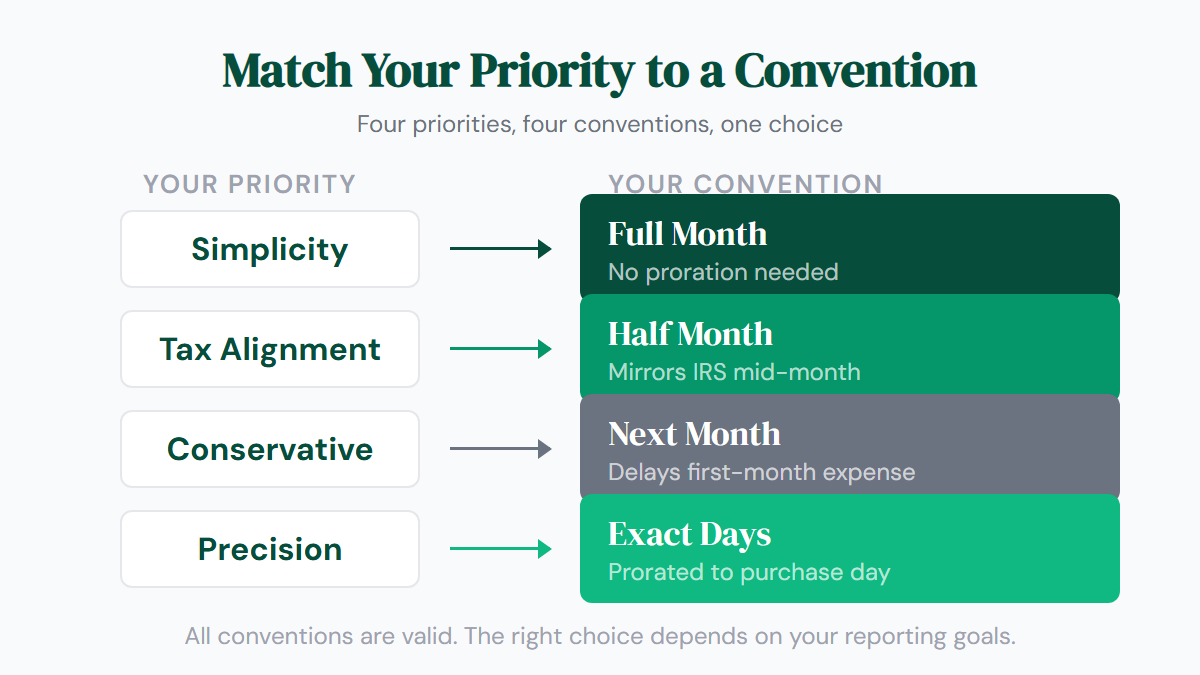
The right convention depends on your company's priorities and industry norms. Match the convention to whichever factor matters most: operational simplicity, tax alignment, conservative reporting, or first-month precision.
| Priority | Recommended Convention | Rationale |
|---|---|---|
| Simplicity above all | Full Month | No proration, no day-counting, auditor-friendly |
| Tax alignment (MACRS) | Half Month | Closest to MACRS half-year convention at monthly level |
| Conservative reporting | Next Month | Delays expense recognition, practical for assets needing setup |
| Maximum precision | Exact Days | Most accurate for high-value, infrequent acquisitions |
If you're unsure, start with full month. It's the default in most asset management systems, the easiest to explain to auditors, and the most forgiving if you occasionally record an acquisition date a few days off. You can always change conventions going forward (though you shouldn't change retroactively - see below).
For companies managing assets across multiple subsidiaries or jurisdictions, consistency within each entity is more important than which convention you pick. All assets within a company should use the same convention. Different companies (e.g., a US subsidiary vs. a UK subsidiary) can use different conventions if local practice dictates it.
Changing Conventions Mid-Stream
Short answer: don't, unless you have a strong accounting reason.
Changing the depreciation convention is a change in accounting estimate under both GAAP and IFRS. It applies prospectively - you don't restate prior periods. But it creates a discontinuity in your depreciation patterns that auditors will question and that complicates period-over-period comparisons.
If you do need to change (for example, after an acquisition that brings in assets using a different convention), apply the new convention only to assets acquired after the change date. Existing assets continue under their original convention. This avoids recalculating accumulated depreciation for the entire register.
The one scenario where a change is justified: you realize the convention was set incorrectly at company creation and has only been applied to a handful of assets. In that case, fix it early before the impact compounds. Correcting a convention after 5 assets is straightforward. Correcting it after 500 is an audit finding.
Frequently Asked Questions
What is a depreciation convention?
A depreciation convention is a company-wide rule that determines how much depreciation is recorded in the month an asset is acquired. The four standard options are full month, half month, next month, and exact days. It's set once and applied to every asset.
Which depreciation convention is most common?
Full month is the most common convention for small and mid-sized businesses. It records a full month of depreciation regardless of the purchase date, eliminating proration and day-counting. It's the default in most asset management systems and auditor-friendly.
Does the depreciation convention change the total depreciation?
No. The convention only shifts when depreciation is recognized between periods - not how much is recognized over the asset's life. Every convention produces the same total depreciation (cost minus residual value) from acquisition to end of useful life.
Can I change the depreciation convention after assets are already set up?
Technically yes, but it's discouraged. Changing the convention is a change in accounting estimate that applies prospectively - typically to assets acquired after the change date only. Retroactive changes require recalculating accumulated depreciation and will draw auditor scrutiny.
What's the difference between half month and exact days conventions?
Half month always records 50% of a month's depreciation in the acquisition month regardless of the purchase date. Exact days prorates based on the actual days remaining - so a June 5 purchase would get 25/30 (about 83%) under exact days but still only 50% under half month.
Ready to automate your asset register?
Minty Assets handles depreciation, journal entries, and audit-ready reports. Free for up to 50 assets, no credit card required.
Start Free