
What Is Net Book Value? Formula and Examples

Your CFO asks for the net book value of the company's vehicle fleet. You open the asset register, filter by Vehicles, and the number is right there: $127,400. But what does that figure actually represent, and why does everyone from auditors to insurance adjusters keep asking for it?
Net book value is the foundation of fixed asset accounting. It's the number on your balance sheet, the starting point for gain/loss calculations on disposal, and the figure auditors reconcile every year-end. Understanding the net book value formula and what makes it move is essential for anyone managing a fixed asset register.
The Net Book Value Formula
Net Book Value = Acquisition Cost - Accumulated Depreciation
Two components:
- Acquisition Cost - the original purchase price plus any costs to get the asset ready for use (delivery, installation, setup). This number is set at acquisition and only changes if you record a capital improvement.
- Accumulated Depreciation - the total depreciation recorded against the asset from its in-service date to the current period. This number grows every month as depreciation is posted.
The result - NBV - represents the undepreciated portion of the asset's cost. It's an accounting construct, not an appraisal. A $50,000 vehicle with $30,000 in accumulated depreciation has an NBV of $20,000 regardless of what a dealer would pay for it.
Some assets also have a residual value (salvage value). Depreciation stops when NBV reaches the residual value. At that point, the asset is fully depreciated but may still be in use.
A Worked Example
Let's track a $15,000 piece of office equipment with a $1,500 residual value and a 5-year (60-month) useful life under straight-line depreciation.
Monthly depreciation: ($15,000 - $1,500) / 60 = $225.00
| Period | Depreciation | Accumulated Dep. | Net Book Value |
|---|---|---|---|
| At purchase | - | $0 | $15,000 |
| After 12 months | $2,700 | $2,700 | $12,300 |
| After 24 months | $2,700 | $5,400 | $9,600 |
| After 36 months | $2,700 | $8,100 | $6,900 |
| After 48 months | $2,700 | $10,800 | $4,200 |
| After 60 months | $2,700 | $13,500 | $1,500 |

At month 60, NBV equals the residual value ($1,500). No more depreciation is recorded. The asset stays on the register at $1,500 until it's disposed.
The pattern is predictable under straight-line: NBV drops by the same amount each period. Under declining balance, NBV falls faster in early years and slows down later, but the formula remains the same - cost minus whatever has accumulated.
What Changes Net Book Value
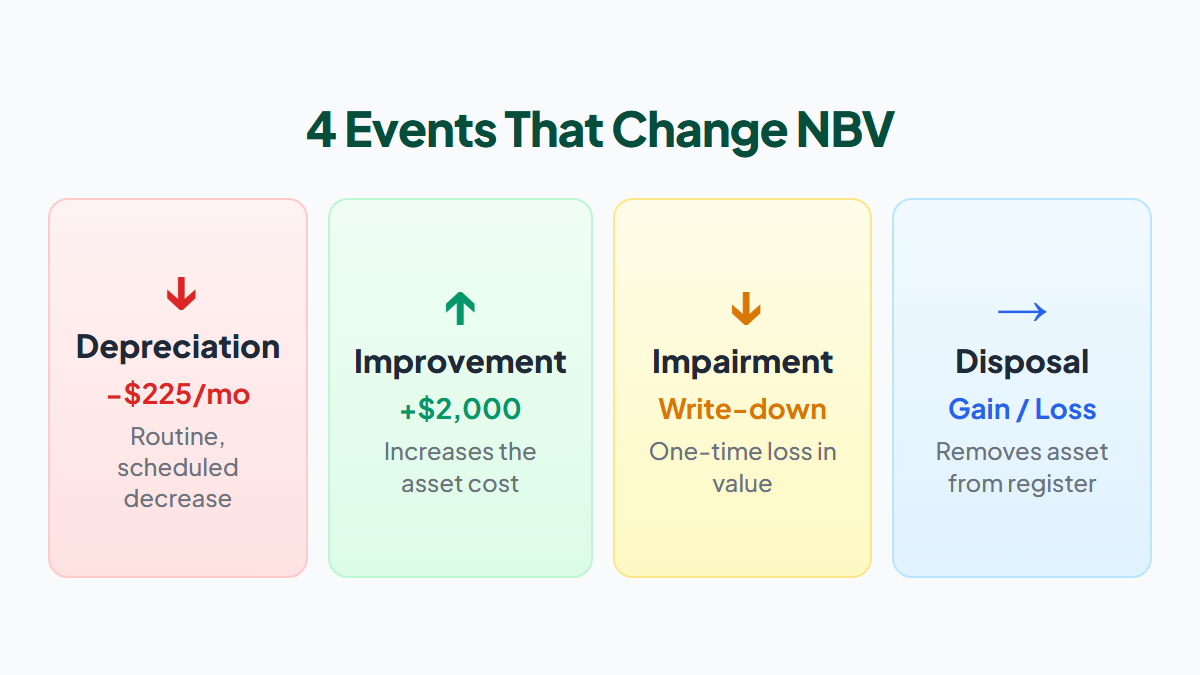
Four events alter an asset's NBV. Only one of them happens on a schedule.
Monthly Depreciation
The routine driver. Each depreciation posting increases accumulated depreciation and decreases NBV by the monthly amount. For our $15,000 equipment, that's $225 per month, every month, for 60 months.
Capital Improvements
A capital improvement increases the asset's cost basis. If you spend $2,000 upgrading the equipment in month 24, the cost becomes $17,000. NBV immediately jumps from $9,600 to $11,600. Future depreciation is recalculated based on the new cost, remaining life, and residual value. (Minty Assets recalculates monthly depreciation automatically when you record an improvement.)
Impairment / Write-Down
If an asset's recoverable value drops below its NBV due to damage, obsolescence, or market conditions, you record an impairment. This is a one-time adjustment that increases accumulated depreciation (or records a separate impairment loss), reducing NBV to the lower amount. Unlike depreciation, impairment is not a scheduled event - it happens when circumstances warrant it.
Disposal
When you sell, scrap, or write off an asset, NBV at the disposal date determines the gain or loss:
- Sale proceeds > NBV = Gain on disposal
- Sale proceeds < NBV = Loss on disposal
- Sale proceeds = NBV = No gain or loss
Example: you sell the equipment after 36 months for $8,000. NBV at that point is $6,900. The gain is $8,000 - $6,900 = $1,100.
NBV vs. Market Value
Net book value is not the same as market value. NBV reflects the undepreciated cost of an asset on the balance sheet, while market value is what a buyer would pay for it today.
Controllers who manage assets for years know this question comes up constantly: "Is the book value what it's actually worth?"
No. And that's by design.
NBV is a cost allocation measure. It tells you how much of the original cost hasn't been expensed yet. It does not attempt to estimate what someone would pay for the asset today.
A delivery van with an NBV of $8,000 might sell for $12,000 on the used market (gain on disposal) or $5,000 at auction (loss on disposal). A custom-built production machine with an NBV of $50,000 might have zero market value if no buyer exists for that specific configuration.
This disconnect is normal and expected. Accounting standards (GAAP and IFRS) require systematic depreciation based on useful life estimates, not periodic reappraisals. The balance sheet reflects historical cost minus accumulated depreciation - not fair market value.
The exception is impairment testing. If there's evidence that an asset's recoverable amount has fallen below its NBV, you write it down. But this is a floor test, not a market-tracking exercise.
Where NBV Appears in Your Financial Statements
Balance Sheet
Fixed assets appear on the balance sheet at net book value. The standard presentation shows:
| Line Item | Amount |
|---|---|
| Property, Plant & Equipment (at cost) | $850,000 |
| Less: Accumulated Depreciation | ($320,000) |
| Net Book Value | $530,000 |
Some companies show a single net line. Others break out cost and accumulated depreciation separately. Either way, the net figure is what contributes to total assets.
Roll-Forward Report
The roll-forward reconciles opening NBV to closing NBV:
Opening NBV + Additions - Depreciation - Disposals = Closing NBV
This is the report auditors request every year-end. It proves that the movement in fixed assets is fully accounted for. If the closing NBV on the roll-forward doesn't match the balance sheet, something was missed.
Disposal Gain/Loss
When an asset is disposed, NBV at the disposal date feeds directly into the gain/loss calculation. Getting NBV wrong means the gain or loss is wrong, which means the income statement is misstated. This is why accurate depreciation tracking matters - every monthly posting builds toward the correct NBV at disposal.

How to Check NBV Across Your Register
A few quick reconciliation habits that prevent year-end surprises:
Monthly:
- After posting depreciation, compare total NBV in the register to the balance sheet GL balance. They should match. If they don't, a depreciation entry was missed or posted to the wrong account.
Quarterly:
- Run the asset register report sorted by NBV descending. Your top 10 assets by value should account for a significant portion of total NBV. Verify these individually - a single error on a high-value asset has more impact than errors across twenty small ones.
- Check for assets with zero or negative NBV that are still marked active. These should either be at their residual value (fully depreciated) or flagged for disposal.
Annually:
- Run the roll-forward report and reconcile to the prior year balance sheet. Opening NBV should match last year's closing NBV exactly.
- Review the fully depreciated assets report. Assets sitting at residual value for years may be candidates for disposal or write-off.
The 80/20 rule applies here: roughly 20% of your assets represent 80% of total NBV. Focus your verification effort on the high-value items first.
Frequently Asked Questions
What is the net book value formula?
Net book value equals acquisition cost minus accumulated depreciation. For example, an asset purchased for $50,000 with $30,000 in accumulated depreciation has an NBV of $20,000.
Is net book value the same as market value?
No. Net book value is an accounting figure reflecting undepreciated cost, not what a buyer would pay. An asset with an NBV of $8,000 might sell for more or less depending on market conditions.
What changes net book value?
Four events change NBV: monthly depreciation (routine decrease), capital improvements (increase), impairment write-downs (one-time decrease), and disposal (removes the asset entirely).
What happens when an asset is fully depreciated?
When NBV reaches the residual value, depreciation stops. The asset remains on the register at its residual value until it is disposed, sold, or written off.
Ready to automate your asset register?
Minty Assets handles depreciation, journal entries, and audit-ready reports. Free for up to 50 assets, no credit card required.
Start Free