Declining Balance Depreciation: How It Works + Calculator

A $40,000 delivery van loses 25% of its resale value the moment it leaves the lot. By year three, it's worth half what you paid. Straight-line depreciation ignores that reality - it charges the same $476 every month for seven years as if the van depreciates at a steady, even pace. Declining balance doesn't.
Declining balance depreciation front-loads expense to match how assets actually lose value. The charge is highest in year one and shrinks each period as the book value drops. This guide covers how the method works, how to pick the right rate, and when it makes more sense than straight-line.
How Declining Balance Works
The core mechanic is different from straight-line in one fundamental way: instead of dividing a fixed amount evenly, you apply a fixed percentage to the remaining book value each period.
- Straight-line: same dollar amount every month
- Declining balance: same percentage every month, but the dollar amount shrinks because the base (NBV) shrinks
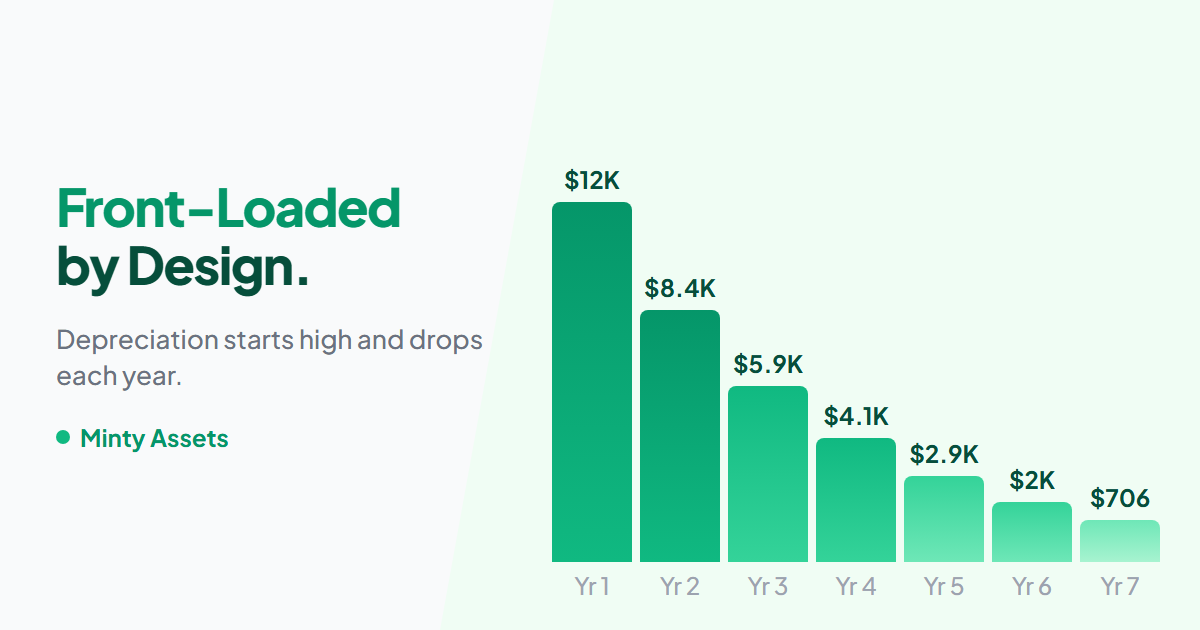
The result is a curve that starts steep and flattens out. Year one has the largest expense. Each subsequent year produces less depreciation than the one before. The total depreciation over the asset's life still equals cost minus residual value - the method changes the timing, not the total.
The Formula
Monthly Depreciation = Net Book Value x (Annual Rate / 12)
Three inputs:
- Net Book Value (NBV) - current book value (cost minus accumulated depreciation to date). This changes every month.
- Annual Rate - the percentage applied per year (e.g., 30%). This stays constant.
- 12 - converts the annual rate to a monthly rate
Unlike straight-line, there's no residual value in the formula itself. The residual value acts as a floor - depreciation stops when NBV reaches it. More on that below.
A Complete Worked Example
Let's follow a delivery van through its full lifecycle.
| Field | Value |
|---|---|
| Asset | 2025 Ford Transit Cargo Van |
| Acquisition Cost | $40,000 |
| Residual Value | $4,000 |
| Useful Life | 7 years (84 months) |
| Depreciation Rate | 30% per year |
Year-by-year breakdown:
| Year | Opening NBV | Depreciation (30%) | Closing NBV |
|---|---|---|---|
| 1 | $40,000 | $12,000 | $28,000 |
| 2 | $28,000 | $8,400 | $19,600 |
| 3 | $19,600 | $5,880 | $13,720 |
| 4 | $13,720 | $4,116 | $9,604 |
| 5 | $9,604 | $2,881 | $6,723 |
| 6 | $6,723 | $2,017 | $4,706 |
| 7 | $4,706 | $706 | $4,000 |
| Total | $36,000 |
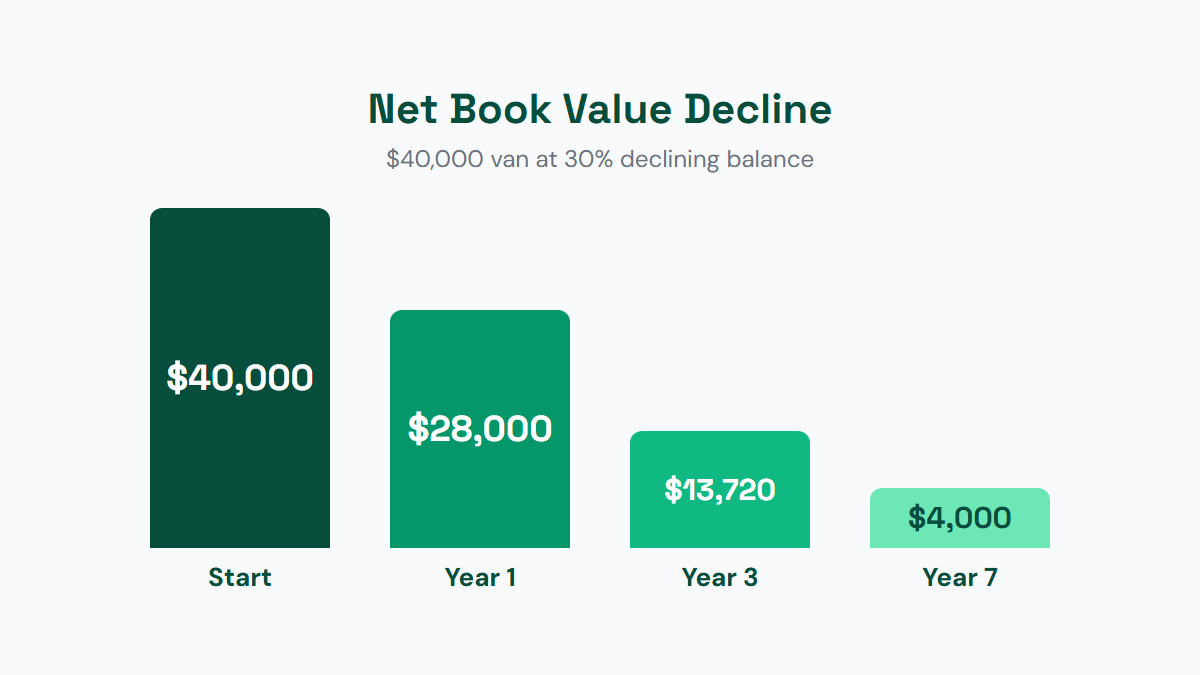
Notice year one: $12,000 in depreciation. Under straight-line, that same van would show $5,143 ($36,000 / 7 years). The declining balance method records more than double the expense in year one, which better reflects the van's actual market value decline.
By year seven, only $706 remains to reach the $4,000 residual floor. The system caps the final year's depreciation at whatever amount brings NBV exactly to residual value. (Minty Assets handles this cap automatically - you set the rate and residual value, and the engine ensures NBV never drops below the floor.)
Monthly detail for Year 1:
The annual rate of 30% translates to 2.5% per month (30% / 12). In January of year one:
$40,000 x 2.5% = $1,000.00
In February, the base has already shrunk:
($40,000 - $1,000) x 2.5% = $975.00
Each month produces a slightly smaller charge than the month before. By December of year one, the monthly amount has dropped to about $781.
Choosing the Right Rate
The rate determines how aggressive the front-loading is. Higher rates push more expense into early years.
Common rates by asset type:
| Asset Type | Typical Rate | Rationale |
|---|---|---|
| Vehicles | 25-30% | Steep early resale decline |
| Production equipment | 20-30% | Heavy early-year usage |
| Computer hardware | 30-40% | Rapid obsolescence |
| Office furniture | 15-20% | Moderate, slower decline |
How the rate relates to straight-line: A useful starting point is 1.5x to 2x the straight-line rate. For a 7-year asset, the straight-line rate is about 14.3% (100% / 7). Multiplying by 2 gives roughly 29% - close to the 30% in our example.
One practical consideration experienced controllers know: the rate you pick should reflect economic reality, not just math. If your fleet manager tells you vans are worth 40% less after three years based on actual trade-in data, work backward from that to find the rate that produces a similar pattern. The theoretical rate matters less than matching the real-world value curve.
The Residual Value Floor
This is where declining balance gets tricky. The formula never naturally reaches zero or a specific residual value. Left unchecked, it would depreciate forever in smaller and smaller amounts, approaching but never reaching the floor.
In practice, the system enforces a hard stop:
- Each month, calculate the normal depreciation: NBV x monthly rate
- Check: would this push NBV below the residual value?
- If yes, cap the depreciation at (NBV - Residual Value) instead
- Mark the asset as fully depreciated
In our van example, year 7 opens at $4,706 with a $4,000 residual. The normal 30% depreciation would be $1,412, but that would push NBV to $3,294 - below residual. So the system records only $706 (the exact amount needed to reach $4,000) and stops.
This is one reason spreadsheet-based asset registers produce errors with declining balance. The floor logic requires an IF statement in every cell, and those formulas break when rows are inserted or deleted.
Declining Balance vs. Straight-Line
Using our $40,000 van with a $4,000 residual over 7 years:
| Year | Declining Balance (30%) | Straight-Line | Difference |
|---|---|---|---|
| 1 | $12,000 | $5,143 | +$6,857 |
| 2 | $8,400 | $5,143 | +$3,257 |
| 3 | $5,880 | $5,143 | +$737 |
| 4 | $4,116 | $5,143 | -$1,027 |
| 5 | $2,881 | $5,143 | -$2,262 |
| 6 | $2,017 | $5,143 | -$3,126 |
| 7 | $706 | $5,143 | -$4,437 |
| Total | $36,000 | $36,000 | $0 |
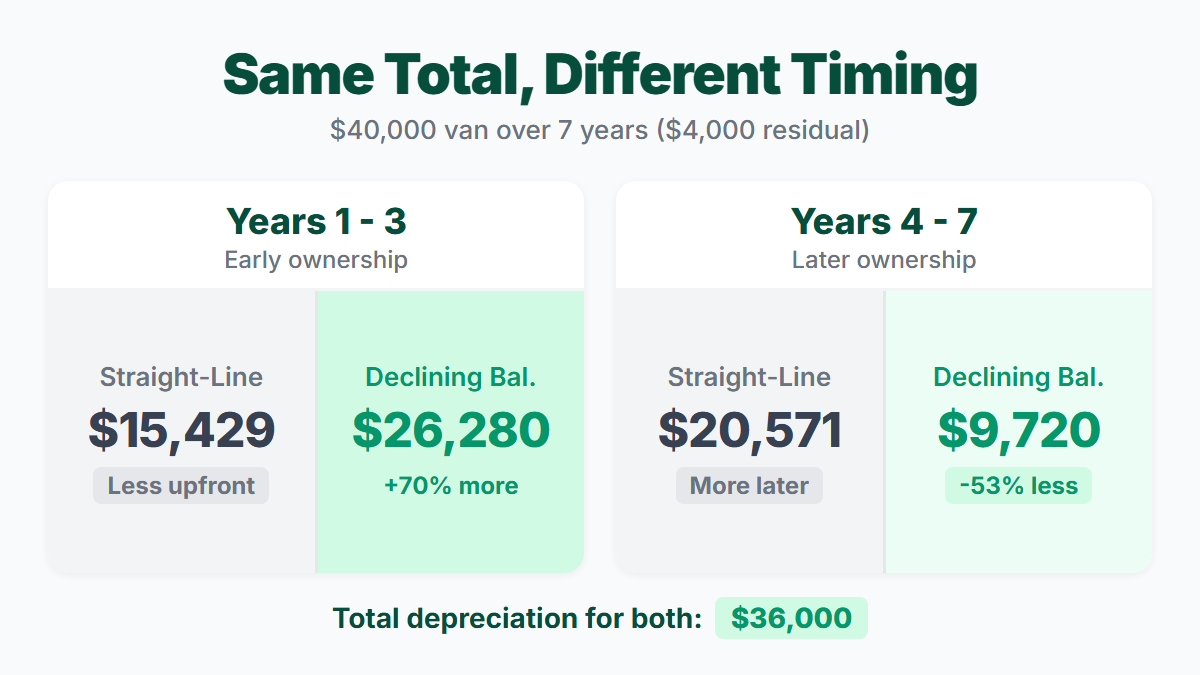
The totals are identical. The timing is what differs. In years one through three, declining balance records $26,280 versus straight-line's $15,429 - a $10,851 gap. That means $10,851 less in reported profit during those early years, offset by higher profits later.
Choose declining balance when:
- The asset genuinely loses value faster in early years (vehicles, production machinery)
- You want book depreciation to approximate market value decline
- Tax strategy benefits from accelerated expense (consult your tax advisor)
Stick with straight-line when:
- The asset delivers equal value each period (furniture, buildings, software licenses)
- Simplicity and predictability matter more than economic matching
- You have no data suggesting the asset's value curve is front-loaded
For a full comparison of all four depreciation methods with worked examples using the same asset, see our depreciation methods guide.
Double Declining Balance: The Accelerated Variant
Double declining balance (DDB) is a specific case where the rate is exactly twice the straight-line rate. For our 7-year van, that would be 28.6% (2 / 7) instead of 30%.
The key difference: DDB automatically switches to straight-line partway through the asset's life when straight-line produces a larger deduction. This prevents the tail-end problem where declining balance produces very small amounts in later years.
DDB is the most aggressive standard method. It's suited for technology assets and equipment that becomes functionally obsolete within a few years. If declining balance is the measured acceleration, DDB is the aggressive one.
Frequently Asked Questions
How does declining balance depreciation work?
Declining balance applies a fixed percentage to the remaining net book value each period. The expense starts high and shrinks as the book value decreases. The total depreciation equals cost minus residual value - only the timing changes.
What rate should I use for declining balance?
Common rates are 25-30% for vehicles, 20-30% for production equipment, and 30-40% for computer hardware. A useful starting point is 1.5x to 2x the straight-line rate for the asset's useful life.
What is the residual value floor?
The residual value floor is the minimum net book value where depreciation stops. Each period, the system checks whether the calculated depreciation would push NBV below the residual value and caps it if so.
When should I use declining balance instead of straight-line?
Use declining balance when an asset genuinely loses value faster in early years - vehicles, delivery trucks, and production equipment are common examples. Stick with straight-line for assets with steady, even consumption like furniture and buildings.
Ready to automate your asset register?
Minty Assets handles depreciation, journal entries, and audit-ready reports. Free for up to 50 assets, no credit card required.
Start Free