Fixed Asset Depreciation: 4 Methods Explained with Examples

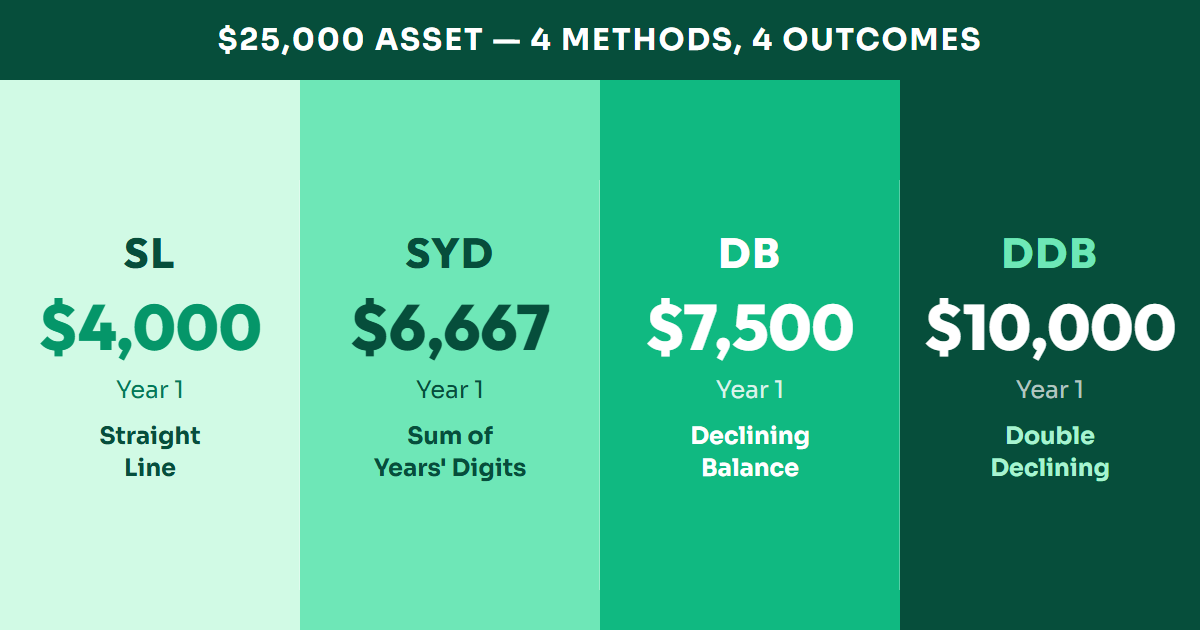
The same $25,000 asset can produce a $5,000 depreciation expense in year one, or a $1,500 one. Same cost, same useful life, same residual value. The only difference is the depreciation method.
That choice ripples through your income statement, your tax planning, and the questions your auditor asks at year-end. Yet most controllers inherit a method from whoever set up the books and never revisit it. This guide walks through the four fixed asset depreciation methods that cover virtually every SME scenario, with worked examples using the same asset so you can compare them directly.
Why the Method Matters More Than You Think
Depreciation is not just a compliance exercise. The method you select determines:
- Reported profit timing - accelerated methods front-load expense, reducing early-year profits and increasing later-year profits
- Tax strategy alignment - if your book and tax methods differ, you're managing two depreciation schedules (and a deferred tax liability)
- Audit scrutiny - auditors rarely question straight-line. Switch to an accelerated method and expect them to ask why
A controller who has managed asset registers for a decade knows this pattern: companies default to straight-line for everything, then wonder why their P&L doesn't reflect the economic reality of assets that lose value fast in their first two years. Matching the method to the asset's actual consumption pattern produces more meaningful financial statements.
For all four methods below, we'll use the same example asset:
| Field | Value |
|---|---|
| Asset | CNC Milling Machine |
| Acquisition Cost | $25,000 |
| Residual Value | $5,000 |
| Useful Life | 5 years (60 months) |
| Depreciable Amount | $20,000 |
Straight-Line Depreciation
The simplest and most common method. Depreciation is spread evenly across the asset's useful life.
Formula:
Monthly Depreciation = (Cost - Residual Value) / Useful Life in Months
Worked example:
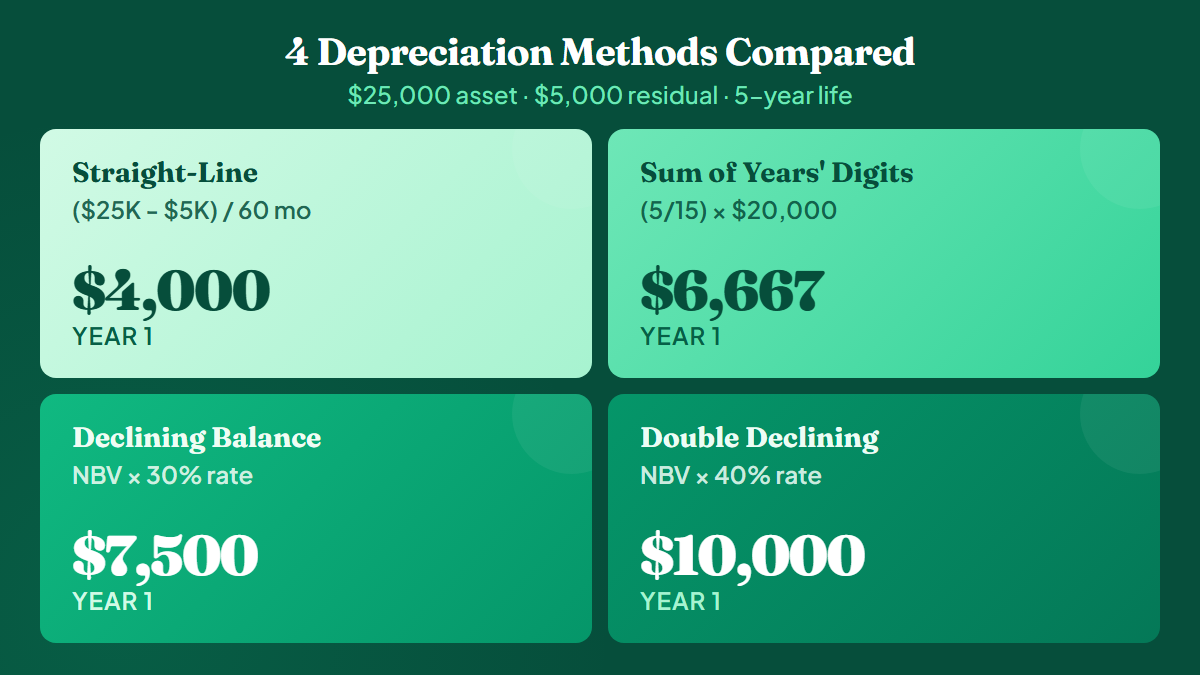
($25,000 - $5,000) / 60 months = $333.33 per month
That's $4,000 per year, every year, for five years. No surprises, no variation.
Where it fits best
Straight-line works for assets that deliver roughly equal value each period. Office furniture, leasehold improvements, and buildings are classic examples. The asset doesn't wear out faster in year one than year four, so equal expense allocation makes economic sense.
It's also the default that auditors expect. If you're a small business with fewer than 100 assets and no strong reason to use an accelerated method, straight-line keeps things simple and defensible.
Declining Balance Depreciation
Instead of a fixed dollar amount, declining balance applies a fixed percentage to the remaining book value each period. The expense starts high and decreases as the book value shrinks.
Formula:
Monthly Depreciation = Net Book Value x (Annual Rate / 12)
Worked example (using a 30% annual rate):
| Year | Opening NBV | Annual Depreciation | Closing NBV |
|---|---|---|---|
| 1 | $25,000 | $7,500 | $17,500 |
| 2 | $17,500 | $5,250 | $12,250 |
| 3 | $12,250 | $3,675 | $8,575 |
| 4 | $8,575 | $2,573 | $6,003 |
| 5 | $6,003 | $1,003 | $5,000 |
Year one expense is $7,500 compared to $4,000 under straight-line. By year five, it drops to $1,003. The total depreciable amount is still $20,000, but the timing shifts dramatically.
Note: in the final year, depreciation is capped so the book value doesn't fall below the residual value.
Where it fits best
Declining balance suits assets that lose productive capacity quickly. Vehicles, delivery trucks, and production equipment that runs heavy early shifts are good candidates. It also aligns book depreciation closer to market value decline for assets that depreciate steeply on resale.
Double Declining Balance (DDB)
DDB is a specific case of declining balance where the rate is exactly twice the straight-line rate. The twist: it automatically switches to straight-line partway through the asset's life when straight-line produces a larger deduction.
Formula:
DDB Rate = (2 / Useful Life in Years) = 2 / 5 = 40%
Monthly Depreciation = Net Book Value x (40% / 12)
Worked example:
| Year | Opening NBV | Annual Depreciation | Method Used | Closing NBV |
|---|---|---|---|---|
| 1 | $25,000 | $10,000 | DDB | $15,000 |
| 2 | $15,000 | $6,000 | DDB | $9,000 |
| 3 | $9,000 | $3,600 | DDB | $5,400 |
| 4 | $5,400 | $200 | Switch to SL | $5,200 |
| 5 | $5,200 | $200 | SL | $5,000 |
Year one hits $10,000 in depreciation, two and a half times the straight-line amount. The automatic switch prevents the asset from being under-depreciated in later years, which is the main advantage over standard declining balance.
Where it fits best
Technology assets - servers, specialized software, manufacturing robots - that become obsolete or significantly less productive within two to three years. DDB front-loads expense to match the steep early decline in usefulness. It's the most aggressive of the four methods. (Minty Assets calculates the DDB-to-straight-line switch point automatically, so you don't need to track it manually.)
Sum of Years' Digits (SYD)
SYD is an accelerated method that uses a declining fraction based on the remaining useful life. The denominator stays constant; the numerator counts down.
Formula:
Sum of Years = 5 + 4 + 3 + 2 + 1 = 15
Year N Depreciation = (Remaining Life / Sum of Years) x Depreciable Amount
Worked example:
| Year | Remaining Life | Fraction | Annual Depreciation | Closing NBV |
|---|---|---|---|---|
| 1 | 5 | 5/15 | $6,667 | $18,333 |
| 2 | 4 | 4/15 | $5,333 | $13,000 |
| 3 | 3 | 3/15 | $4,000 | $9,000 |
| 4 | 2 | 2/15 | $2,667 | $6,333 |
| 5 | 1 | 1/15 | $1,333 | $5,000 |
SYD produces a smoother acceleration curve than DDB. Year one is $6,667 (versus DDB's $10,000), and it declines steadily rather than dropping sharply.
Where it fits best
Assets where the decline in value is real but not as extreme as DDB suggests. Construction equipment, specialized tools, and medical devices are practical examples. SYD is less common in practice than declining balance, but it provides a middle ground between straight-line and the aggressive DDB curve.
Side-by-Side: How $25,000 Depreciates Under All Four Methods
Here's the same CNC milling machine under each method, year by year:
| Year | Straight-Line | Declining Balance (30%) | Double Declining (40%) | Sum of Years' Digits |
|---|---|---|---|---|
| 1 | $4,000 | $7,500 | $10,000 | $6,667 |
| 2 | $4,000 | $5,250 | $6,000 | $5,333 |
| 3 | $4,000 | $3,675 | $3,600 | $4,000 |
| 4 | $4,000 | $2,573 | $200 | $2,667 |
| 5 | $4,000 | $1,003 | $200 | $1,333 |
| Total | $20,000 | $20,001 | $20,000 | $20,000 |
Every method reaches the same destination - $5,000 residual value. The path differs. Straight-line is flat. Declining balance and SYD create a moderate curve. DDB front-loads aggressively then tapers to almost nothing.
The practical implication: if you switch a fleet of vehicles from straight-line to declining balance mid-year, your depreciation expense could jump 40-80% for that period. Plan the P&L impact before changing methods.
How to Choose the Right Method
Forget memorizing formulas. The decision comes down to one question: how does this asset lose its value?
| Asset Type | Recommended Method | Rationale |
|---|---|---|
| Office furniture, fixtures | Straight-line | Steady use, minimal obsolescence |
| Buildings, leasehold improvements | Straight-line | Long-lived, predictable consumption |
| Vehicles, delivery trucks | Declining balance | Steep early resale value drop |
| Computers, servers | Double declining balance | Rapid obsolescence cycle |
| Production machinery | Declining balance or SYD | Heavy early use, declining output |
| Software licenses | Straight-line | Fixed term, equal-period benefit |
| Medical/lab equipment | SYD | Moderate acceleration, long tail |
| Construction equipment | Declining balance | Hard early use, maintenance-heavy later |
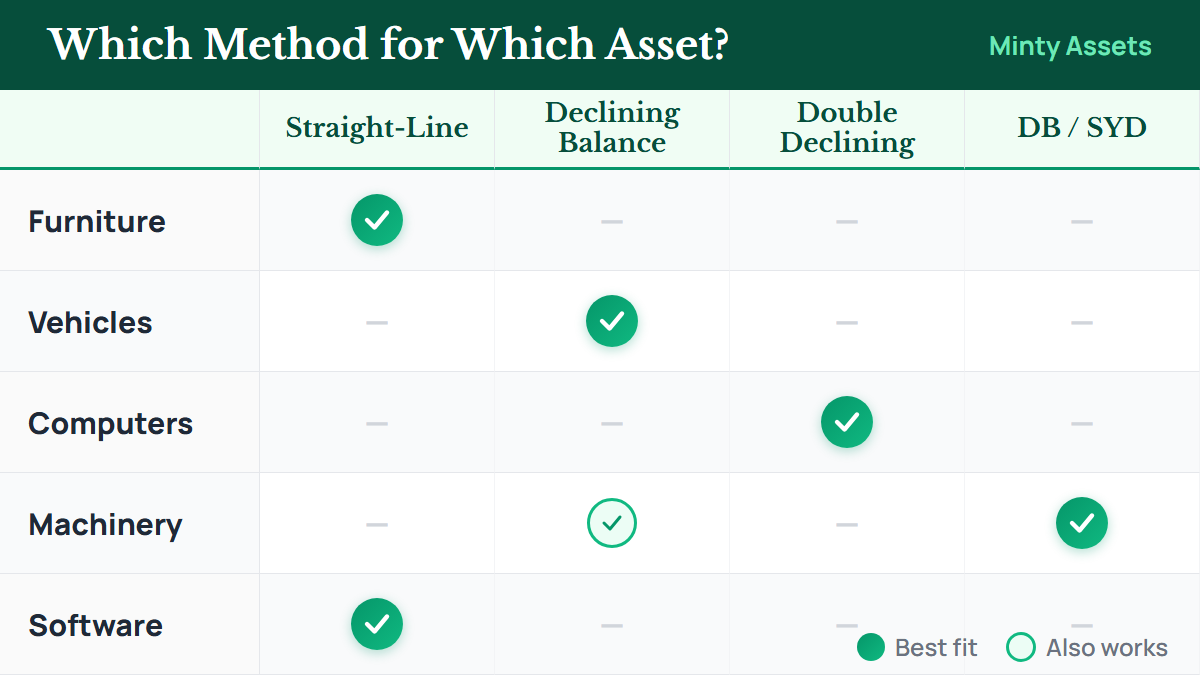
One pattern experienced controllers follow: use straight-line as the default at the category level, then override to an accelerated method only for specific categories where the economic rationale is clear. This keeps 80% of your register simple while handling the exceptions properly.
A common mistake is using tax depreciation rates (like MACRS) for book purposes. Tax lives are shorter by design to incentivize investment. Book depreciation should reflect actual useful life, not tax recovery periods. If your vehicles are on a 5-year MACRS schedule but you keep them for 7 years, your book register should use 7 years.
Setting It Up in Practice
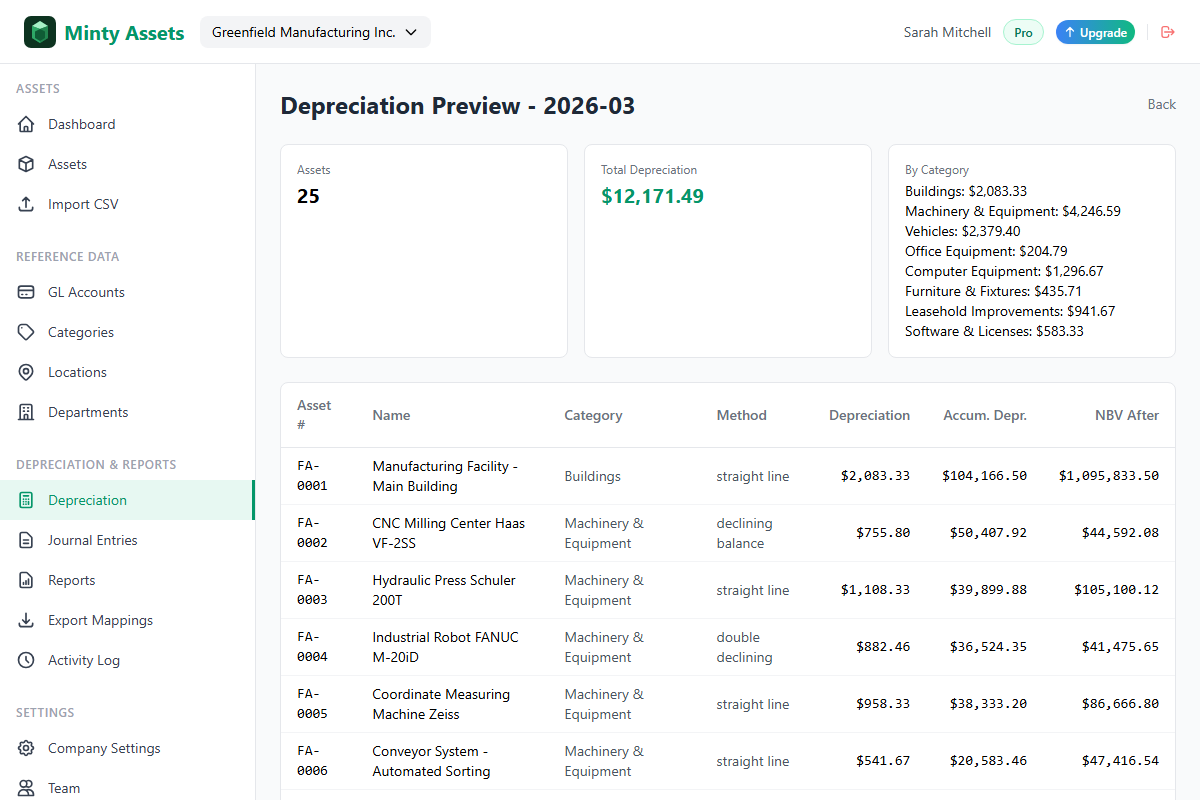
The cleanest approach is to configure depreciation methods at the category level, not per asset. Set your "Vehicles" category to declining balance at 30%, your "Computer Equipment" to double declining balance, and everything else to straight-line. When you add a new asset and select a category, the method, useful life, and residual value percentage pre-populate automatically.
This prevents the inconsistency that creeps in when each asset is configured individually - where one laptop is straight-line over 3 years and another is declining balance over 5, with no clear reason for the difference.
If you set up your fixed asset register with category-level defaults from the start, method selection becomes a one-time decision per asset class rather than a per-asset judgment call.
Frequently Asked Questions
What are the four depreciation methods?
The four standard methods are straight-line, declining balance, double declining balance (DDB), and sum of years' digits (SYD). All four produce the same total depreciation over the asset's life but distribute it differently across periods.
Which depreciation method is most common?
Straight-line is the most common method for book depreciation. It spreads expense evenly across the asset's useful life and is the method auditors expect to see for most asset categories.
How do I choose a depreciation method?
Match the method to how the asset loses value. Use straight-line for assets with steady consumption (furniture, buildings). Use declining balance or DDB for assets that lose value faster in early years (vehicles, technology hardware).
Can I use different methods for different assets?
Yes. Set the depreciation method at the category level - for example, straight-line for furniture and declining balance for vehicles. Each asset inherits its category's method automatically.
Ready to automate your asset register?
Minty Assets handles depreciation, journal entries, and audit-ready reports. Free for up to 50 assets, no credit card required.
Start Free