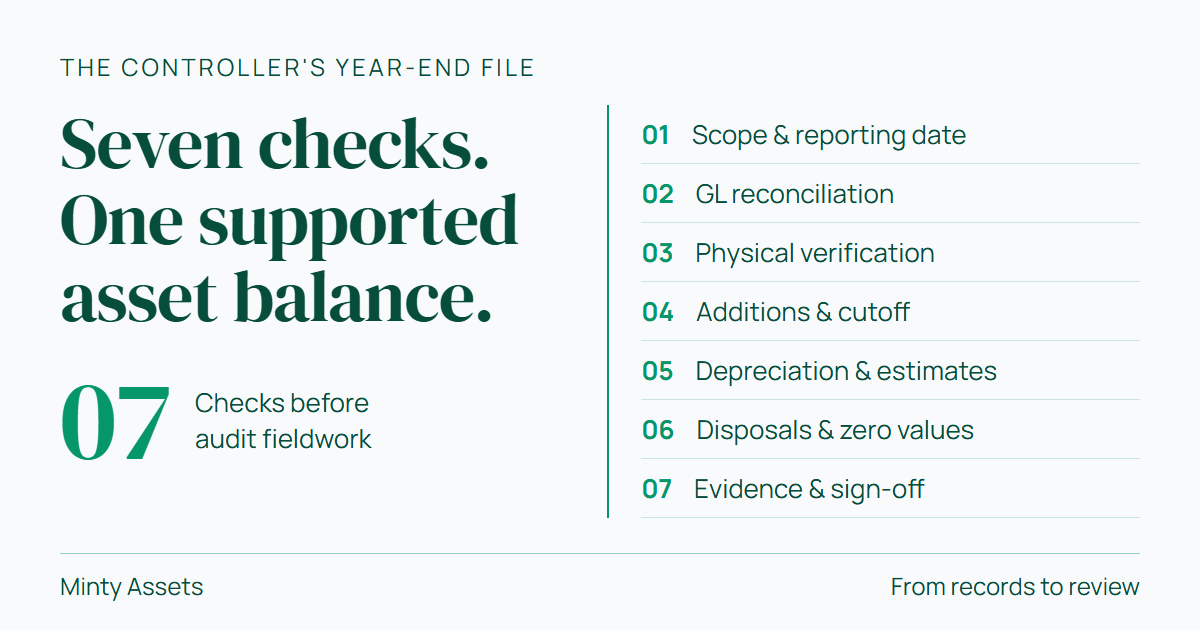
Fixed Asset Audit Checklist for Year-End

A fixed asset register can agree to the balance sheet and still contain equipment that left the building months ago. It can also omit a machine sitting on the factory floor. A fixed asset audit needs more than matching totals: finance must connect the accounting balances to physical assets, supporting documents, and the right reporting period.
This checklist helps SME controllers and bookkeepers prepare that connection before fieldwork begins. It focuses on tangible assets and book accounting, with IFRS requirements identified where relevant. Use it to organize management's preparation; the external auditor determines the audit procedures, materiality, and sample sizes for the engagement.
1. Define your fixed asset audit scope and reporting date
Start with the legal entity, year-end date, currency, and accounting framework. List the asset classes and locations included, then identify separate schedules such as construction in progress or leased equipment. Assign a preparer and reviewer, and agree delivery dates for the auditor's requested information.
Save a dated copy of the register and the corresponding general ledger (GL) balances. Record the filters used, including whether disposed assets are excluded. A report generated today may show current status rather than status at year-end, so verify how the selected report handles historical movements before using it as a closing schedule.
Keep a short change log after the first extract: journal reference, asset number, reason, amount, and replacement report version. Close pressure creates a practical trap: one person sends the auditor a register while another posts a late adjustment. Numbering the extracts and maintaining one agreed reconciliation prevents two accurate files from describing different versions of the accounts.
2. Reconcile cost and accumulated depreciation to the GL
Reconcile gross cost and accumulated depreciation separately by asset category and GL account. Matching net book value alone can conceal offsetting differences. Begin with the prior year's agreed closing balances, explain the year's movements, and compare the calculated closing totals with the final trial balance.
In this cost-model example, gross cost is the capitalized asset amount before depreciation, and accumulated depreciation is the total depreciation recognized to date on the assets still recorded. Net book value is their difference when no impairment or other valuation adjustments apply.
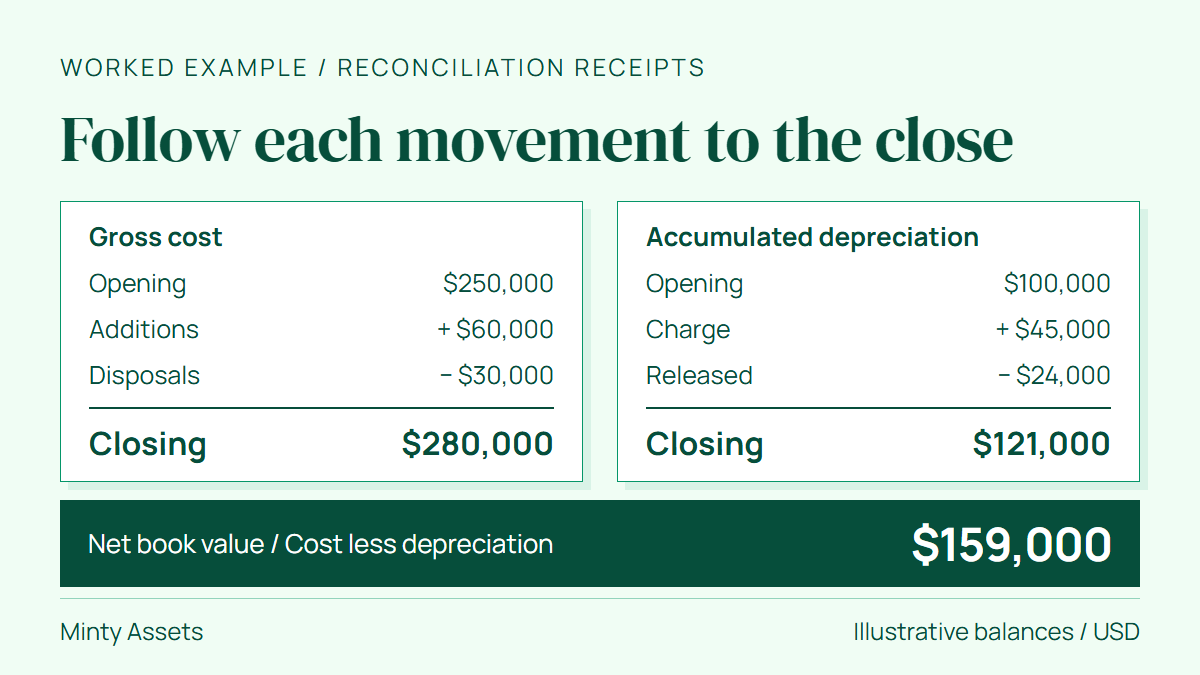
Consider this simplified equipment category. Assume no impairment, revaluation, transfers, or held-for-sale movements. The disposed equipment originally cost $30,000 and had $24,000 of accumulated depreciation at disposal; the $45,000 annual charge includes all depreciation required up to disposal dates.
| Movement | Gross cost | Accumulated depreciation | Net book value |
|---|---|---|---|
| Opening balance | $250,000 | $100,000 | $150,000 |
| Additions | $60,000 | $0 | $60,000 |
| Depreciation charge | $0 | $45,000 | ($45,000) |
| Disposal removal | ($30,000) | ($24,000) | ($6,000) |
| Closing balance | $280,000 | $121,000 | $159,000 |
Accumulated depreciation is displayed as a positive contra-asset balance. The closing calculation is $280,000 less $121,000, giving $159,000. If the GL instead reports gross cost of $282,000, investigate the $2,000 difference: it might be an unrecorded addition, miscoding, or an unsupported manual journal. Do not post a balancing amount without identifying its cause.
Match each reconciling item to evidence and an owner. Check that depreciation expense also agrees to the relevant GL postings, allowing for any amounts capitalized into another asset under the applicable policy. The fixed asset journal entries guide explains the postings behind these movements.
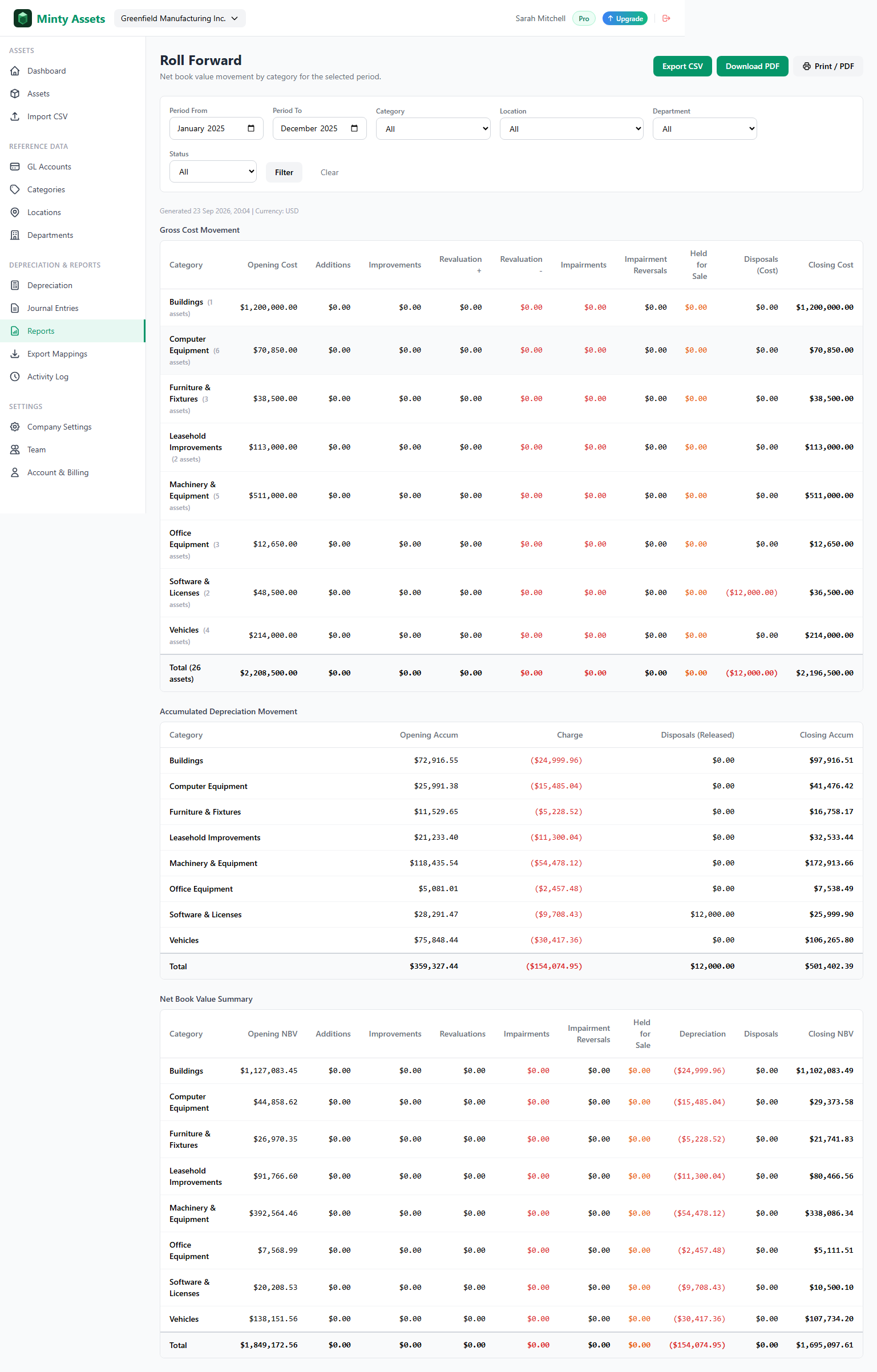
(Minty Assets provides a roll-forward report with separate gross cost, accumulated depreciation, and net book value sections, exportable as CSV or PDF.)
The screenshot below illustrates the report structure using Greenfield Manufacturing's demo data for January through December 2025. Its company balances are separate from the simplified equipment example above. Preserve the same reporting period and filter settings when exporting your own supporting schedules.
3. Verify physical assets and investigate missing records
Physical verification works in two directions. Trace selected register entries to the equipment to test existence. Then select equipment at the premises and trace it back to the register to test completeness. These procedures answer different questions, as explained in ACCA's guidance on audit assertions.
Record the asset number, serial number, location, custodian, inspection date, and condition. Include assets held off-site, such as laptops with remote staff or equipment at a repair contractor. Arrange appropriate supporting evidence for those items rather than assuming that absence from the premises means disposal.
Maintain an exception list for missing tags, unmatched equipment, location differences, and damage. An untagged machine may already be recorded under another description; creating a new entry immediately can duplicate its cost. Likewise, a missing asset needs investigation before a write-off is approved. If the count occurs before or after year-end, reconcile intervening additions, transfers, and disposals to the reporting date.
4. Check additions, ownership, and year-end cutoff
For additions, assemble invoices, purchase approvals, delivery evidence, and documentation of when the equipment became available for use. Match the supplier and description to the register, and confirm that the supporting records identify the correct legal entity. Physical possession alone does not establish ownership or determine the accounting for a lease.
Examine transactions on both sides of year-end, including subsequent supplier invoices and receipts. A machine delivered in December but invoiced in January may require a December asset and payable or accrual, depending on the contractual facts. A December deposit for equipment delivered later is not automatically an in-service depreciable asset. Trace the substance of the transaction instead of relying on invoice dates alone.
Review significant repairs and maintenance charges for possible capital items, and examine additions for costs that belong in expenses. Document the capitalization policy and the reasoning behind borderline decisions. The capital improvement versus repair guide provides examples; the fixed asset audit file should retain the actual invoice and assessment supporting your conclusion.
5. Review depreciation, useful lives, and impairment indicators
Recalculate selected charges from cost, residual value, useful life, method, and the relevant start date. For example, equipment costing $24,000 with a $4,000 residual value over five years produces $4,000 annual straight-line depreciation, or approximately $333.33 per full month before rounding adjustments. Check partial periods against the documented convention and applicable accounting requirements.
Confirm that every required period has been posted and investigate duplicate batches or unexplained reversals. Compare unusual movements with additions and disposals before attributing them to calculation errors. Keep tax depreciation separate from book depreciation so that a tax allowance does not silently become the financial reporting schedule.
Under IAS 16, review residual values, useful lives, and the depreciation method at least at each financial year-end. Depreciation starts when an asset is available for use. Support revisions with operational evidence, such as maintenance assessments or replacement plans; changes in estimates affect current and future periods as applicable. See IAS 16 requirements reproduced in AASB 116, paragraphs 51, 55, and 61.
Ask operations about damage, idle equipment, obsolete technology, or discontinued production. Under IAS 36, indications of impairment require a recoverable-amount assessment for tangible assets within its scope; the observations alone do not establish the loss. Retain the assessment and approvals, including the rationale where no adjustment is needed. Escalate valuation questions early enough to obtain specialist input when necessary.
6. Validate disposals and fully depreciated assets
Match disposals to authorization, sale documentation or scrapping evidence, and cash receipts where applicable. Verify the disposal date, cost removed, accumulated depreciation released, and resulting gain or loss. Check that sold assets have been removed from the closing balance without deleting the historical transaction trail.
Using the reconciliation example, the disposed equipment's carrying amount is $30,000 minus $24,000, or $6,000. Proceeds of $8,000 produce a $2,000 gain, assuming no selling costs or other adjustments. The receipt belongs in the disposal calculation; it is not the amount deducted from gross asset cost. The asset disposal guide covers the related journal entries.
Inspect fully depreciated equipment that remains in service and retain its record while appropriate. Zero book value does not mean that the equipment has been scrapped. For abandoned equipment, assess whether benefits remain from use or disposal: idleness alone does not justify derecognition. IAS 16 requires derecognition on disposal or when neither source of future benefit remains; preserve historical records after removal from the recognized balance. See IAS 16 requirements reproduced in AASB 116, paragraph 67 and the guide to fully depreciated assets still in use.
7. Assemble the evidence pack and sign off exceptions
Organize the fixed asset audit pack so a reviewer can follow a balance from the trial balance to a movement schedule, an asset record, and its source evidence. Use consistent references rather than sending loosely named files across several email chains. Include the accounting policy, reconciliation, register extract, depreciation schedule, physical verification results, and support for material transactions and judgments.
Tie the property, plant, and equipment disclosures back to these schedules, and check the applicable framework's disclosure requirements, including accounting policies and significant restrictions on assets.
Use this final handover checklist to record completion:
- Balances: Cost, accumulated depreciation, and relevant expense accounts agree, or differences are explained.
- Movements: Additions, disposals, and other adjustments have evidence and journal references.
- Physical checks: Missing items and unrecorded equipment have documented outcomes.
- Estimates: Useful lives, residual values, and valuation concerns have been assessed.
- Exceptions: Each open item has an owner, financial impact assessment, and due date.
- Review: The preparer and reviewer have dated their sign-offs against the final file version.
After approved adjustments, regenerate affected schedules and replace superseded exports in the handover pack. Preserve earlier versions in your working records, and clearly identify unresolved matters for the auditor. A useful fixed asset audit checklist ends with evidence of what was checked, who reviewed it, and what still needs a decision.
Frequently Asked Questions
What should a fixed asset audit checklist cover?
Cover scope and reporting date, GL reconciliation, physical verification, additions and cutoff, depreciation and estimates, disposals, and the evidence pack. Assign owners to unresolved differences and document reviewer sign-off.
What is the difference between existence and completeness testing?
Tracing register entries to physical equipment tests existence. Selecting equipment on site and tracing it back to the register tests completeness.
How do you reconcile fixed assets to the general ledger?
Reconcile gross cost and accumulated depreciation separately by category and account. Explain additions, depreciation, disposals, and other movements; then compare closing balances with the final trial balance.
Should idle or fully depreciated assets be removed from the register?
Neither idleness nor completed depreciation alone justifies removal. Under IAS 16, derecognize on disposal or when no future economic benefits are expected from either use or disposal, and preserve the historical record.
Ready to automate your asset register?
Minty Assets handles depreciation, journal entries, and audit-ready reports. Free for up to 50 assets, no credit card required.
Start Free