Fixed Asset Management Software for Small Business

At 4:30 on the last day of close, a controller is looking for a laptop that was replaced six months ago. The old laptop is still depreciating in the spreadsheet, the new one was booked to office expense, and neither person who handled the change is available. That is how fixed asset management becomes a finance problem rather than an administrative task.
Small businesses do not need an enterprise asset program to avoid this situation. They need a repeatable process: a reliable register, clear capitalization decisions, a monthly depreciation routine, and records that explain what changed. Fixed asset management software can support that process without turning month-end into a separate project.
Why fixed assets become a problem
Fixed assets become difficult to manage when the purchase record, the asset register, and the general ledger live in separate places. The invoice may be in an AP system, the asset details in a spreadsheet, and the depreciation entry in a monthly journal. A small mismatch can persist for months because no single report connects all three.
The first warning signs are familiar: people cannot explain a net book value, month-end depreciation takes longer than posting it, or the auditor asks for a roll forward that has to be assembled by hand. The underlying issue is not the number of assets alone. It is the absence of one source of truth for cost, useful life, accumulated depreciation, location, ownership, and disposal status.
An effective register gives every capitalized item a stable identity and enough context to answer practical questions. It should show what the item is, when it entered service, where it is, how it depreciates, which accounts it affects, and what happened to it after purchase. That information supports accounting, operational tracking, and audit evidence at the same time.
Fixed asset management software is most helpful when it makes these records easier to maintain without hiding the accounting logic behind them.
What a complete fixed asset process includes
A usable fixed asset process has six connected parts. Skipping one creates a gap that usually appears during close or audit fieldwork.
| Process element | What it answers | Minimum information |
|---|---|---|
| Capitalization policy | Should this cost be an asset? | Threshold, asset classes, treatment of repairs |
| Asset register | What does the company own? | Asset number, description, cost, dates, status |
| Depreciation policy | How is cost allocated? | Method, useful life, residual value, convention |
| Monthly close | What changed this period? | Additions, disposals, depreciation, reconciliations |
| Physical verification | Does the register reflect reality? | Location, custodian, tag or serial number |
| Reporting and evidence | Can the balance be explained? | Register, schedule, roll forward, journals |
Start with the capitalization policy. It sets the line between a current-period expense and a cost that will provide benefit over more than one reporting period. The exact threshold is an administrative materiality policy, not a universal dollar amount, and it cannot justify expensing a qualifying amount that is material individually or in aggregate. A $500 monitor might be expensed under one policy and capitalized under another when it is part of a larger equipment deployment.
Then decide what counts as an asset record. A good rule is to create a record for each item that needs its own useful life, location, custodian, or disposal decision. Ten identical chairs acquired together may be one record if they will be managed together. A server, a vehicle, and a production machine nearly always need their own records because their lifecycle events differ.
Build the register before you calculate depreciation
The asset register is the working record behind the balance-sheet line. Before adding formulas or choosing software, define the fields and conventions that make it dependable.
Use consistent categories and account mappings
Categories make the register usable at scale. They group similar assets, apply sensible useful-life defaults, and connect assets to the right fixed-asset, accumulated-depreciation, and expense accounts. Common categories include computer equipment, furniture and fixtures, vehicles, machinery, leasehold improvements, and software.
Avoid creating a new category for every vendor or purchase. Categories should describe the accounting treatment, not the invoice source. If one printer has a different life because of its condition or expected use, document the exception on the asset record rather than fragmenting the chart of categories.
Capture the dates that drive accounting
Purchase date and in-service date are not interchangeable. The purchase date identifies when the company obtained the item. The in-service date identifies when it was available for use, which is normally the point at which book depreciation begins. For a machine that arrives in March and completes installation in April, using the in-service date prevents depreciation from starting before the asset is ready.
Record the acquisition cost, residual value, useful life, method, and start convention at setup. Those inputs drive the depreciation calculation, so changing them later without a reason makes the history hard to explain. Store the purchase order, invoice reference, serial number, and responsible person where the finance team can retrieve them during review.
Establish a numbering convention people will use
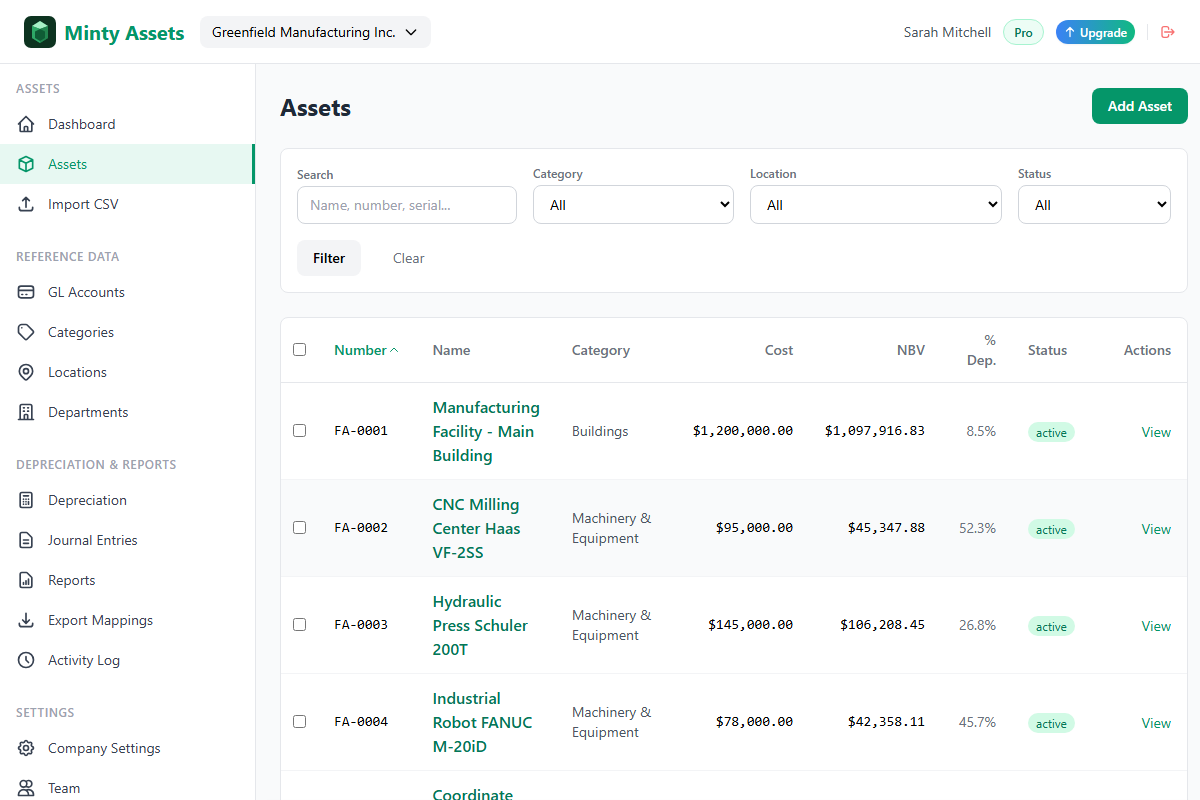
An asset number is a control, not a decorative label. A simple sequential format such as FA-0001 prevents duplicate records and gives finance, operations, and auditors a shared reference. Put the number on a physical label when the asset is movable or high value. For lower-value pooled assets, the number can remain a register identifier.
The practical benefit appears during a disposal or verification. "The Dell laptop" is ambiguous. "FA-0148, assigned to Sales, serial number ending 8421" can be traced to a cost, accumulated depreciation balance, and event history in minutes.
Run a disciplined monthly close
Fixed asset management should fit into close, not compete with it. The objective is to make every period's movements visible before depreciation is posted.
First, review additions. Compare capital expenditure or fixed-asset-account activity in the general ledger with new records in the register. Investigate items recorded to an asset account without an asset record, as well as asset records that do not appear in the GL. This simple two-way check catches a surprising number of timing and coding errors.
Second, review changes. Transfers, improvements, impairments, disposals, and write-offs should be recorded as events rather than edits that overwrite the original cost. That preserves the audit trail and keeps the asset schedule understandable. A separate disposal workflow is especially important because it must clear both the cost and accumulated depreciation.
Third, preview depreciation before posting it. Review the total by category, investigate material movements from the prior month, and confirm that no asset falls below its residual value. A controller with experience starts with the highest-value assets and unusual movements, then scans the remaining exceptions.
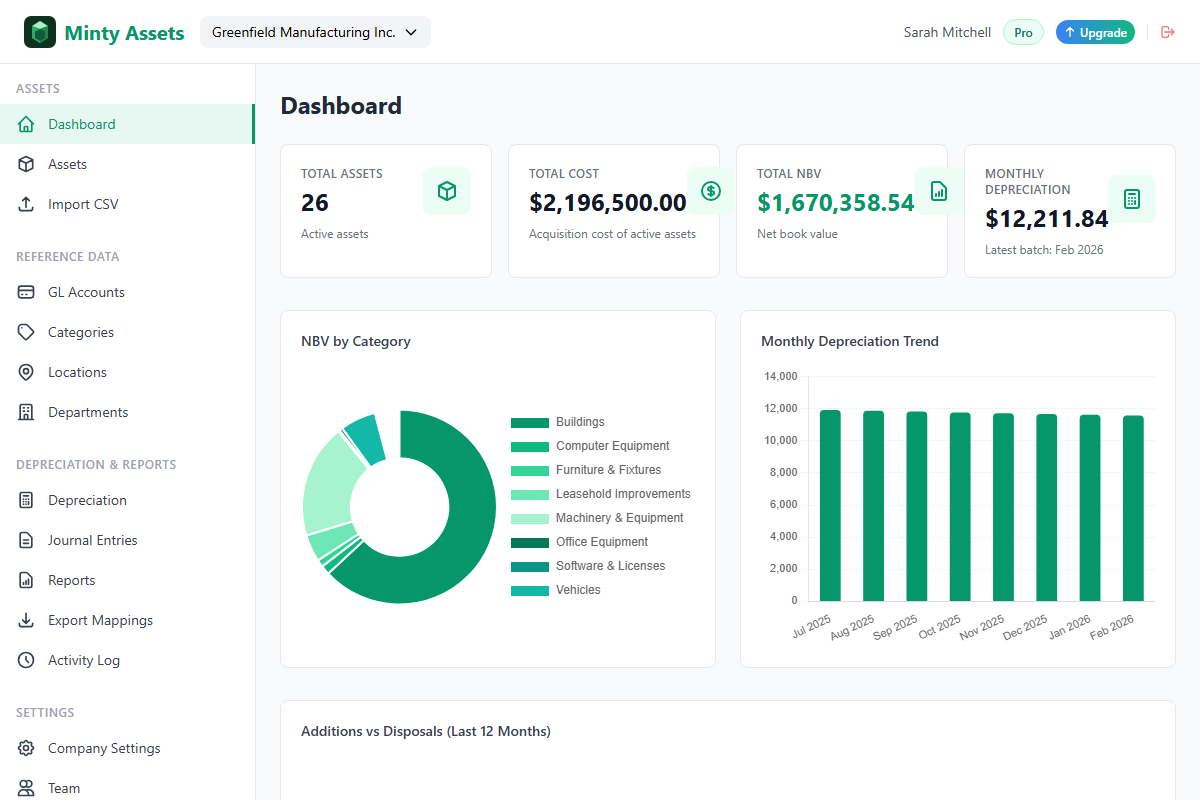
Finally, reconcile the result. The depreciation expense in the register should agree to the journal entry and the GL. The closing net book value should be supportable by the register and, at period end, by the roll forward report. When the same data produces the depreciation schedule, journal entries, and reports, reconciliation becomes a review task instead of a reconstruction task.
(Minty Assets keeps the register, depreciation preview, generated journals, and audit trail together so the same asset data drives each stage of close.)
A 30-day setup plan for a small business
A clean starting point is more valuable than a rushed import. The following plan works for a company moving from a spreadsheet or building its first formal register.
When evaluating fixed asset management software during this process, test the import and reconciliation workflow with a small, representative data set before committing the full register.
- Week 1 - set the policy and data standard. Confirm capitalization threshold, categories, useful-life guidance, depreciation method, and who can approve changes. Decide which fields are mandatory for each record.
- Week 2 - clean the existing list. Remove duplicates, mark assets already disposed, fill in missing acquisition dates, and identify items with unknown cost or life. Keep uncertain records on a review list instead of inventing values.
- Week 3 - load and reconcile opening balances. Import or enter the cleaned records, including accumulated depreciation for existing assets. Reconcile total cost and accumulated depreciation to the latest closed GL.
- Week 4 - test the close. Run a depreciation preview for one period, inspect the category totals, review the journal entry, and export a register and roll forward. Fix setup gaps before the next live close.
For example, suppose a company has $240,000 of equipment cost and $96,000 of accumulated depreciation at month-end. Those figures should tie to the opening register before a new monthly batch is run. If the system calculates $3,850 of April depreciation, the expected closing NBV is $140,150 before additions, disposals, or other movements. This is the kind of simple control calculation that makes an implementation trustworthy.
Controls that prevent recurring errors
The best controls are small enough to survive busy periods. Require an invoice or other source document for new additions. Limit changes to useful lives and residual values to designated roles. Record the reason and effective date for material estimates changes. Reconcile the register to the GL every month, even if the reconciliation is brief.
Physical verification matters too. Choose a rolling cycle that checks high-value and portable assets more frequently than low-risk furniture. When an item cannot be found, do not silently remove it from the spreadsheet. Investigate it, determine whether it was transferred, disposed, stolen, or simply mislabeled, and record the outcome as an event.
Auditor attention often turns to unexplained changes, missing support, and balances that cannot be reconciled. A reasonable, consistently applied depreciation policy and clear evidence are more useful controls than a complicated workbook.
When fixed asset management software is worthwhile
Fixed asset management software is worthwhile when the manual process no longer provides a reliable audit trail, timely depreciation, or repeatable reporting. The threshold is different for every company, but the decision becomes clear when the team is maintaining formulas, versioning files, or rebuilding reports every month.
Look for a system that supports the accounting policy you actually use, not a long list of enterprise features. For a small business, the essentials are configurable categories, useful lives and methods, depreciation preview and posting, automatic journal entries, imported opening accumulated depreciation, disposal handling, and reports that reconcile. If multiple people work in the register, role-based access and a visible event history matter just as much.
The right system creates a dependable chain from purchase to financial statement: one asset record, one set of calculations, and one explanation for every movement. That is fixed asset management that remains manageable as the business grows.
Frequently Asked Questions
What is fixed asset management?
Fixed asset management is the process of tracking long-lived assets from acquisition through depreciation, transfer, verification, and disposal. A reliable process connects the asset register to the general ledger and supporting documents.
What should a small business asset register include?
At minimum, include an asset number, description, category, cost, acquisition and in-service dates, useful life, residual value, depreciation method, location or custodian, and current status.
How often should fixed assets be reconciled?
Reconcile additions, disposals, depreciation, and closing net book value to the general ledger at least monthly. Investigate material differences before the period is closed.
Ready to automate your asset register?
Minty Assets handles depreciation, journal entries, and audit-ready reports. Free for up to 50 assets, no credit card required.
Start Free